In Escape from Freedom, Erich Fromm argues that freedom is more than most people can carry. The free individual feels small, isolated and powerless. There are two ways out: spontaneous acts of love and work, which build the self by exercising it, or bonds that offer security and comfort at the cost of the self.
We give up our freedom in three ways. We fuse with another person or a movement. We set about destroying whatever in the world makes us feel small. Or we conform, in acts that seduce us into believing we are still choosing.
I agree with much of what Fromm puts forward. What I cannot find is any sense of degree. His escapes are total. The self is surrendered, replaced, or handed over. His positive freedom is total as well: spontaneity arrives only when a man represses no essential part of himself, has become transparent to himself, and has brought the spheres of his life into integration. All three conditions are absolute. By that standard, almost nobody has ever been free.
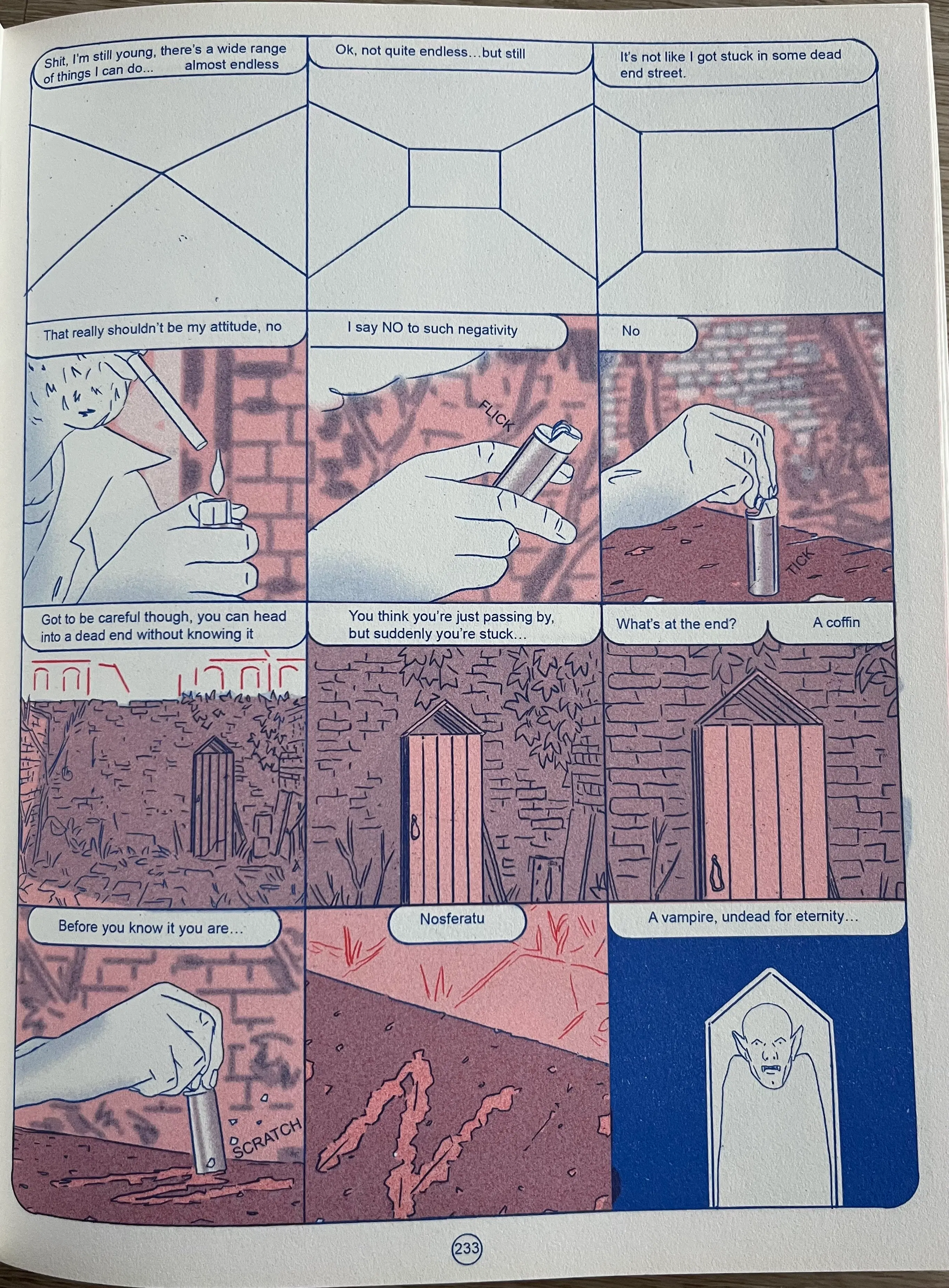
Most lives run between those poles. I hold my tongue in a meeting to keep my job, then spend the evening playing guitar for an audience of nobody. Fromm would classify the first as automaton conformity and the second as a spontaneous act of work. He offers no way to describe the person who does both. While he never rules the mix out, he gives no language for it, By the last chapter freedom reads as something you either have or you do not.
What I think Fromm should say is this: Going along with things costs nothing while you can still feel yourself doing it. The danger isn't how often you hold your tongue, it's the moment you stop noticing that you did.
Researching alongside the text, it seems that Isiah Berlin’s essays on liberty are a good place to pick up the thread. For now, here are my notes from most chapters of Escape From Freedom.
Chapter 1: Freedom - A Psychological Problem
We crave freedom but cannot handle it.
Modern European and American history centers on one effort: to break the political, economic, and spiritual shackles that bound men. As the oppressed fought, one tie after another was severed. Man overthrew the domination of nature and made himself her master. He overthrew the Church, then the absolutist state. He won his freedom. And the more he won, the less he knew what to do with it.
Escape from Freedom is Erich Fromm's account of why. He published it in 1941, trying to explain how a modern, educated, liberated people had handed itself to fascism. The first chapter raises important questions. Is freedom only the absence of external pressure, or is it also the presence of something, and if so, what? Can freedom become a burden too heavy to bear, something a man tries to escape? What forces a man to adapt to almost any condition of life, and where are the limits of that adaptability?
Everything that follows rests on a claim Fromm makes before he makes any other, and it puts him against the dominant psychology of his day. Freud held that we are born with instinctual drives society must tame. Too much taming produces neurosis. The right amount redirects the drive into something the culture values, a process he called sublimation: aggression into competitive sport, sexual energy into art. On that account a man arrives complete, and society applies pressure from outside.
Fromm starts elsewhere. The key problem of psychology is how the individual relates to the world. A man is made by his relations, and his need for them runs as deep as hunger. That claim is what turns freedom into a psychological problem. If a man is constituted by his ties, then every tie he cuts takes something from him, and the history of liberation reads differently: each victory is also a loss.
So how does society get inside a man? Fromm splits adaptation in two. Static adaptation is a change of habit that leaves character intact: a man raised on chopsticks learns to use a knife and fork, and he is the same man afterward. Dynamic adaptation changes him. A boy submits to a strict father and bottles the hostility he cannot show. The hostility turns into anxiety, and the anxiety becomes part of who he is. He did not choose it, he cannot see it, and it will shape what he wants for the rest of his life.
Dynamic adaptation is the machinery of Fromm’s argument. It works on the pliable traits of character: love, destructiveness, the lust for power, self-aggrandizement. And it starts at birth. A man has to eat and drink, so he has to work, and he works under conditions the society he was born into has already fixed for him. Neither his need to live nor the social order is his to alter. Together they shape everything about him that can be shaped.
Against all that plasticity Fromm sets a small fixed core. Two needs do not bend. A man must satisfy his physiologically conditioned drives, and he must avoid isolation and moral aloneness.
Moral aloneness is the one that does the work. It has little to do with solitude; a man can be morally alone in a crowd. It is the condition of being cut off from the values, symbols, and patterns that hold a society together, belonging to nothing and holding nothing that makes his own life legible to him. Food and shelter do not touch it. It is unbearable the way hunger is unbearable, and a man will do almost anything to end it.
The chain closes here. Freedom in the modern sense was won by severing ties: to nature, to the Church, to the absolutist state, to the fixed place a man once held in a fixed order. Those ties were also what stood between him and moral aloneness. Cut them all and a man is free and unbearably alone. He can carry the freedom only if he has something to put where the ties used to be. With nothing there, he starts looking for a way out, and submission is a way out.
That is the thesis the rest of the book has to prove: we win our freedom, and then we discover we cannot hold it.
Chapter 2: Defining Freedom
All men are born unfree. We begin in deep dependence on our parents for security and for our sense of self. Over time we work loose, and we call the result freedom. Fromm splits that word in two. Freedom from is what we win by breaking those ties. Freedom to is the capacity to make something of ourselves once they are broken. The first arrives on its own. The second does not.
At birth, man is the most helpless animal there is. We arrive unable to feed or fend for ourselves. Our parents meet our needs and go on supporting us along the long path to adulthood. Fromm calls this security our primary ties.
Over time the ties loosen. Education and experience make us more independent and self-aware. Individuation begins, and we develop an identity of our own. We start to want freedom from the ties we once needed.
We win it by breaking them, and we lose what they provided. Loss begets aloneness. We find ourselves disconnected from the world, and Fromm holds that we cannot bear it. Freedom from is the whole of what breaking ties gives us. It leaves a man free with nothing to do with his freedom.
Freedom to is spontaneous connection with the world. By spontaneous, Fromm seems to mean acting from an impulse that is your own; maybe authentic is a more appropriate description. Love and productive work are his examples. Two men build the same chair. One chose the trade, and the work connects him to the world. The other took it from his father, and it does not. The chairs are identical. The relation is not.
Freedom to is hard to reach. Social, economic, and political conditions stop people from realizing their ambitions, and they are left holding a freedom they cannot use. So they trade it. They submit to a power that promises the safety the primary ties once gave, and the promise is kept. The aloneness ends.
What ends with it is growth. The new tie has the shape of the old one, and that is why the surrender feels like relief. A man does not experience it as defeat. He experiences it as coming home. We are born unfree, we spend our lives getting out, and when the way forward closes we go back the way we came and call it safety.
Chapter 3: Freedom in the Age of Reformation
The medieval order
Fromm begins in the twelfth century, where the social order assigned each man his place. He had little chance of moving between classes, and he found comfort, security, and belonging inside the constraint. Tradition set his livelihood, and the livelihood fixed his place in the hierarchy.
Guilds ran on mutual cooperation. Scores of small businesses gave their members economic stability, most of them serving one town or village. Competition was limited and capital accumulated slowly.
Economic interests were subordinate to salvation. The rules of morality kept individuals and business owners from breaking with the standing order. Seeking more than a livelihood in one's station was avarice, a deadly sin.
Medieval society did constrain a man, but it did not leave him alone. He was chained to his role, unable to move class or town, sometimes unable to choose what he wore or ate. What he had in exchange was a place that was distinct, unchangeable, and unquestionable from the moment of birth, and a life whose meaning left no room and no need for doubt. He was identical with his role. The individual, in the modern sense, had not yet appeared.
Capitalism arrives
The emergence of capitalism shook the order. Fromm gives several examples; I will follow the craftsmen.
Guild differentiation began around the fourteenth century. Some members held more capital and could employ more journeymen. Some guilds began admitting only those with capital, and others became monopolies. Other guild members were impoverished. As the journeyman's path to master closed, the journeymen organized, struck, and rose in revolt.
Capitalism grew stronger. Commerce moved from the neighborhood to the nation to the world. Big companies threatened the small businessman and set prices the consumer sometimes could not reach. Cooperation gave way to competition.
Capitalism loosened the ties that bound a man to his position. Every class lost what those ties had supplied. Individualism and social mobility became possible, and freedom from tradition opened onto freedom to. A man was his own master, and his path now depended on his own effort.
The change reached the classes unequally; the two freedoms were of unequal weight. Only the most successful class profited enough to enjoy what the new freedom offered, expanding and amassing fortunes through their own activity. The wealthy pursued pleasure and felt the threat of competition. The middle classes envied the wealthy and worked to hold the lower classes down, since they wanted the order stabilized rather than uprooted. The lower classes were simply exploited. Socioeconomic conditions still constrained a man. He was free and stuck at once, and feelings of isolation and aloneness took hold.
The Reformation
Luther and Calvin gave that condition a theology. Both movements drew their adherents from the same place: the conservative middle class, artisans and small businessmen, some more prosperous than others, all of them threatened by the rise of capitalism. Neither doctrine appealed to the advanced capitalist groups.
Luther
In Germany, Luther broke the individual's dependence on the Church and made salvation a matter between a man and God directly. In its place he set total submission.
Nothing you do bears on your righteousness. The Law exists to prove it, holding up a standard no one meets, until a man despairs of his own resources. Only then can he hear the promise, since a gift cannot be received by someone who believes he is owed. God then declares him righteous on Christ's account and credits him with a righteousness that was never his. He stays a sinner. The verdict stands anyway.
What follows is release. The question is closed and nothing he does can reopen it, so his energy turns outward. God has no need of his good works; his neighbour does. He remains in the station he was born to and serves the people in front of him, with no religious reason to rise above it.
Fromm reads the same doctrine as a trade. Luther freed people from the authority of the Church and made them submit to a more tyrannical authority, a God who required the annihilation of the individual self as the condition of salvation. Accept your own insignificance, efface yourself utterly, and you are released from the feeling of your own nothingness and may participate in God's glory. Faith, in this reading, is the conviction of being loved on condition of surrender, and Fromm notes that it has much in common with complete submission to the state and the leader.
The same deference runs through Luther's politics. He fought the Church, resented the new moneyed class, and backed the peasants up to a point, and still insisted on submission to worldly princes in the most drastic terms, on the grounds that authority is good and from God even when those holding it are not.
Calvin
In Switzerland, Calvin took it further. Salvation and damnation are settled before a man is born, and nothing he does can alter the verdict. Some are the Elect, the rest the Preterite. Why God chose one and condemned the other is a secret a man must not try to enter; He did it because it pleased Him to display His power that way.
Two consequences follow that Fromm treats as more important than the theology.
The doctrine strips human will of any weight. No teaching could state the worthlessness of human effort more strongly, and the man who holds it is a powerless tool in God's hands.
And it denies the equality of men in principle, since men are created, saved or damned with no act of theirs able to change it. Fromm marks this as the principle that found its most vigorous revival in Nazi ideology, and notes that a doctrine of racial inequality is the same principle with a different rationalization.
The paradox of effort
Predestination should have produced fatalism. It produced frantic effort instead.
The anxiety of not knowing is unbearable. Almost nobody in that state can relax and wait, so activity becomes the escape from it: not effort born of confidence, but a desperate flight from doubt. A man awaiting a diagnosis paces, cleans his desk, writes letters.
Effort took on a second function. Since nothing could change the verdict, unceasing effort became a sign of having been chosen. The activity does not produce an outcome; it forecasts one already fixed, which Fromm compares to a compulsive neurotic counting windows on a street, or a man playing solitaire to learn his future. In time the effort moved from moral striving to work, and success became the sign of grace, failure the sign of damnation.
Fromm calls the result the most important psychological change since the end of the Middle Ages. Medieval man worked to earn his livelihood, with no urge to work beyond the traditional standard of living, and for some groups work was enjoyed as a realization of productive ability. Modern man is driven by an internal compulsion that works him harder than any master could, because against external compulsion there is always some rebelliousness, and against this there is none. Man became his own slave driver. Fromm ranks the drive to relentless work alongside steam and electricity among the forces that built the industrial system.
Hostility
Fromm also reads both doctrines as expressions of repressed hostility. This makes the chapter psychoanalytic rather than historical.
The middle class was thwarted, threatened, and envious of the capitalists' luxury, and could express none of it directly. The lower classes could hate the rich openly and wanted to overthrow them. The upper classes could express aggression as the pursuit of power. The middle class wanted the order stabilized and each of its members hoped to rise inside it, so the hostility could not be voiced or even consciously felt. Repression removed it from awareness without abolishing it, and the pent-up feeling spread through the whole personality in disguised forms.
It returned three ways.
Projected onto God. Calvin's deity, arbitrary and merciless, condemning part of mankind for no reason beyond a display of power, is the middle class's own hostility and envy given a face.
Discharged as moral indignation. Envying those who had wealth and could enjoy life, the class rationalized the envy as moral outrage and the conviction that such people would be punished eternally.
Turned against the self. Both men taught the wickedness of man and made self-humiliation the basis of virtue. Fromm argues this humility is rooted in a violent hatred blocked from reaching the outside world and turned inward instead. It appears as a man's insistence on his own worthlessness, and as conscience and duty. Conscience, in his phrase, is a slave driver a man installs in himself: it drives him toward aims he takes for his own when they are the internalization of external social demands, forbidding pleasure and making his life the atonement for some mysterious sin.
Where the chapter lands
The breakdown of feudal society meant one thing for every class: the individual was left alone and isolated. He was free. The freedom had two results at once. He lost the security and the unquestioned belonging, and he was torn from a world that had answered his need for safety both economically and spiritually, so he felt alone and anxious. He was also free to act and think independently, to become his own master and do with his life what he could, rather than what he was told.
My reading
Freedom from is clear enough: freedom from an authority or system that fixes a man's place lets him direct himself. Freedom to stays hazy through these chapters. The only account so far is the mention of spontaneous work and love back in chapter 2.
I am not convinced the socioeconomic conditions were ever strong enough to prevent a man from spontaneous or authentic love. And the work half remains open to interpretation. Does a chosen trade count? Can a man profit from the work? Or does Fromm mean something closer to play, uncoupled from a livelihood?
Even granting that a man reaches freedom to, I doubt it can be a lasting state. We all seem to waver in the middle. I work for a company that requires certain compromises and sacrifices. I do not have freedom from that company. And without it I would lack the means for much of what I do outside of work, which is where whatever freedom to I have actually lives.
Chapter 4: Two Aspects of Freedom for Modern Man
In Chapter 4, Fromm ultimately argues against the ideas that self-interest and egotism motivate human activity. Economic activity, success and material gains become ends themselves in capitalistic society. It becomes man’s fate to contribute to the growth of the economic system such that he becomes a cog in the machine.
Luther and Calvin prepared man to accept this fate. Their doctrines lead to the absence of self love. Absence resulted in insecurity. And insecurity spurred selfish actions through which people tried to fill the void that it created. Man appeared to act in self interest and self preservation, but he always falls short, perpetuating a cycle that feeds the system.
Man came to measure his self worth in terms of his possessions, which never seemed enough. He also measured his worth through his relationships, though Fromm argues these were at best a temporary balm. Once again, man throws himself into his work, aligning with a corporate interest or way of living that reduces his positive freedom and, to a degree, his negative freedom.
The 'self' in the interest of which modern man acts is the social self, a self which is essentially constituted by the role the individual is supposed to play and which in reality is merely the subjective disguise for the objective social function of man in society.
Chapter 5: Mechanisms of Escape
In the face of loneliness, isolation and powerlessness, Fromm posits three primary mechanisms of escape: authoritarianism, destructiveness and automaton conformity. All three relieve the feeling of unbearable anxiety by removing the person's awareness of being alone. None of them ends the aloneness itself, which is why Fromm calls them escapes rather than solutions. They are also compulsive. The person does not select them the way one selects a strategy, and they cannot be revised when they fail.
Authoritarianism
Authoritarianism requires giving up one's independence and fusing with someone or something outside oneself. The new bond supplies the strength the individual was missing, at the cost of the self that would have borne it.
Fromm breaks authoritarianism into two strivings: masochistic and sadistic. Masochism means surrendering yourself to someone else. Sadism means controlling others.
Masochistic strivings appear around feelings of inferiority, powerlessness and insignificance. These individuals latch onto others to fill the void. The target may be a cult leader or a political figure, or something larger like a religion or a political movement. The individual derives their sense of worth and large parts of their identity from the target. Where the target becomes a person invested with the power to protect and to understand on one's behalf, Fromm calls it the magic helper, and the individual's own capacities go undeveloped because they have been delegated. These strivings rarely announce themselves. They get rationalised as love, loyalty, duty, or illness.
Sadistic tendencies take three forms: make others dependent on oneself and hold power over them; exploit others and incorporate what is theirs; harm others or watch them suffer. Only the third involves cruelty in the ordinary sense, which is why the first two go unrecognised. Think of the overbearing mother who does not let her son lead his life in his own way, or the micromanager who justifies his existence through nitpicking. Fromm's point is that sadism need not be destructive. Benevolent control is still sadism.
What links the two strivings is that both dissolve the boundary of the isolated self. The masochist fuses upward and the sadist fuses downward, and both end up as dependent on their object as the other is on theirs. The sadist needs the person he dominates in order to have a self at all. This is why the lust for power is a sign of weakness, and why Fromm treats sadism and masochism as one configuration rather than as opposites.
The authoritarian character admires power as such. It submits to those who have it and holds contempt for those who lack it, and these two movements are the same structure seen from two sides. It also accepts as authority whatever cannot be altered: fate, destiny, natural law, the past.
Fromm distinguishes three forms authority can take. Overt authority commands and can be disobeyed. Internalised authority speaks as duty and conscience. Anonymous authority speaks as common sense, public opinion, science, and what is normal. The third is the most effective, because it issues no command. There is nothing to disobey and nobody to rebel against, so submission to it feels like ordinary good judgment.
Destructiveness
Destructiveness offers a second mechanism of escape. Again the individual seeks relief from feeling small against the surrounding world, and here he sets out to remove whatever makes him feel that way.
What separates this from sadism is the fate of the object. The sadist requires his victim to survive so that domination can continue. The destroyer wants the thing gone and needs no relation to it. Both flee the same isolation by opposite means.
The more the drive towards life is thwarted, the stronger is the drive towards destruction. The more life is realised, the less is the strength of destructiveness. Destructiveness is the outcome of unlived life. This is Fromm's alternative to Freud's death instinct, and it carries a consequence: destructiveness varies with conditions, so changing the conditions can reduce it.
Like the other escapes, destructiveness gets rationalised. Fromm notes it presenting itself as love, duty, conscience and patriotism.
Automaton conformity
Automaton conformity offers a third avenue of escape, and it is the hardest to spot because it does not feel like escape. The individual ceases to be himself. He adopts the personality offered to him by cultural patterns and becomes exactly as all others are and as they expect him to be. Nothing is being submitted to, so nothing is felt.
Fromm argues that we can have thoughts, feelings and wishes which we subjectively feel to be ours while they have been put into us from outside and are alien. He grounds this on hypnosis. A subject given a post-hypnotic suggestion produces the thought, invents reasons for it, feels complete conviction, and would deny any influence. The pseudo act is indistinguishable from the original act from the inside. The contents of our thinking, feeling and willing are induced from outside to an extent that gives the impression that pseudo acts are the rule, while genuine mental acts are the exception.
A great number of our decisions are not our own. They are suggested to us, and we persuade ourselves that we made them, when we have conformed with the expectations of others, driven by the fear of isolation and by more direct threats to our life, freedom and comfort.
The cost is the self that would have done the deciding. What remains is what Fromm calls the pseudo self, which is the agent of others' expectations rather than the origin of acts. Because it takes its identity from recognition, losing the original self increases conformity. The person has to keep being confirmed, since there is nothing else to confirm them.
Chapter 7: Freedom and Democracy
Skipping Fromm's analysis of Nazism in Chapter 6, the final chapter turns to what positive freedom looks like.
The right to express our thoughts is meaningful only if we have thoughts of our own. He does not mean the thought must be unthought before. He means the individual arrives at it by their own seeing rather than adopting it whole.
Throughout the book Fromm speaks of spontaneity, by which he means the active expression of an individual's emotional and intellectual potentialities. It takes shape as creative activity operating in one's emotional, intellectual and sensuous experience, and in one's will. The word carries its root sense of acting of one's own accord, which rules out compulsion, including internal compulsions like duty and drivenness. One premise for spontaneity is the acceptance of the total personality and the elimination of the split between reason and nature. Only if a man does not repress essential parts of his self, only if he has become transparent to himself, and only if the different spheres of life have reached a fundamental integration, is spontaneous activity possible.
Fromm puts forward love and work as the two powerful forms of spontaneous activity.
Love means the union of an individual with others on the basis of the preservation of the individual self. Here I am reminded of communion as a storytelling mode in the work of Dan P. McAdams. We connect through love, friendship, dialogue, community and care, so long as the individual self survives the connection. This is what separates love from the masochistic dependence of Chapter 5, where union is achieved by dissolving one of the two people.
In work, man becomes one with nature in the act of creation. Fromm does not clarify whether nature here means the natural world he emerged from in Chapter 2 or the individual's own suppressed inner nature. The second is my reading, though the parallel with love points the other way, since love is a relation to something outside the person.
Fromm's emphasis falls on the activity rather than the result. He goes as far as saying there is no meaning to life beyond the act of living itself. The target of the objection is worth that gets determined from outside the self, which is the market orientation he described in Chapter 4, where a person's value is their exchange value and can collapse without any change in them. Take guitar playing. Wanting to play well is part of the activity, and finding out whether you can is how the activity proceeds. The problem arrives when your standing as a musician, granted by other people, becomes the thing that tells you what you are worth.
There is a further consequence. Fromm holds that the self is as strong as it is active. The strength required to bear freedom is produced by acting, rather than being a precondition of it, which is why his answer to the burden of freedom runs forward through spontaneous activity instead of backward toward the security that individuation destroyed.