Of Human Bondage
William Somerset Maugham
Critics hail Of Human Bondage as a masterpiece. It’s Maugham’s opus, they say. While it certainly ranks among the influential 20th century Bildungsromans, I say it sucks. Much of my ire comes down to the insufferable protagonist, Philip Carey.
Philip rejects the religion his surrogate parents push upon him. Good! Philip aspires to be an artist in Paris and fails. Great! Philip pursues a relationship with Mildred. Game over! Mildred whips this spineless little weasel around for two-thirds of the novel. Philip’s inability to stand up for himself made me cringe. Perhaps Maugham imagined Philip as a masochist.
Mildred is insufferable, and Philip in turn for his unwillingness to get rid of her. If only he treated her with the disdain that he laid out on the lovely Ms. Carey: But her tears were partly tears of happiness, for she felt that the strangeness between them was gone. She loved him now with a new love because he had made her suffer.
The movie poster says it all.
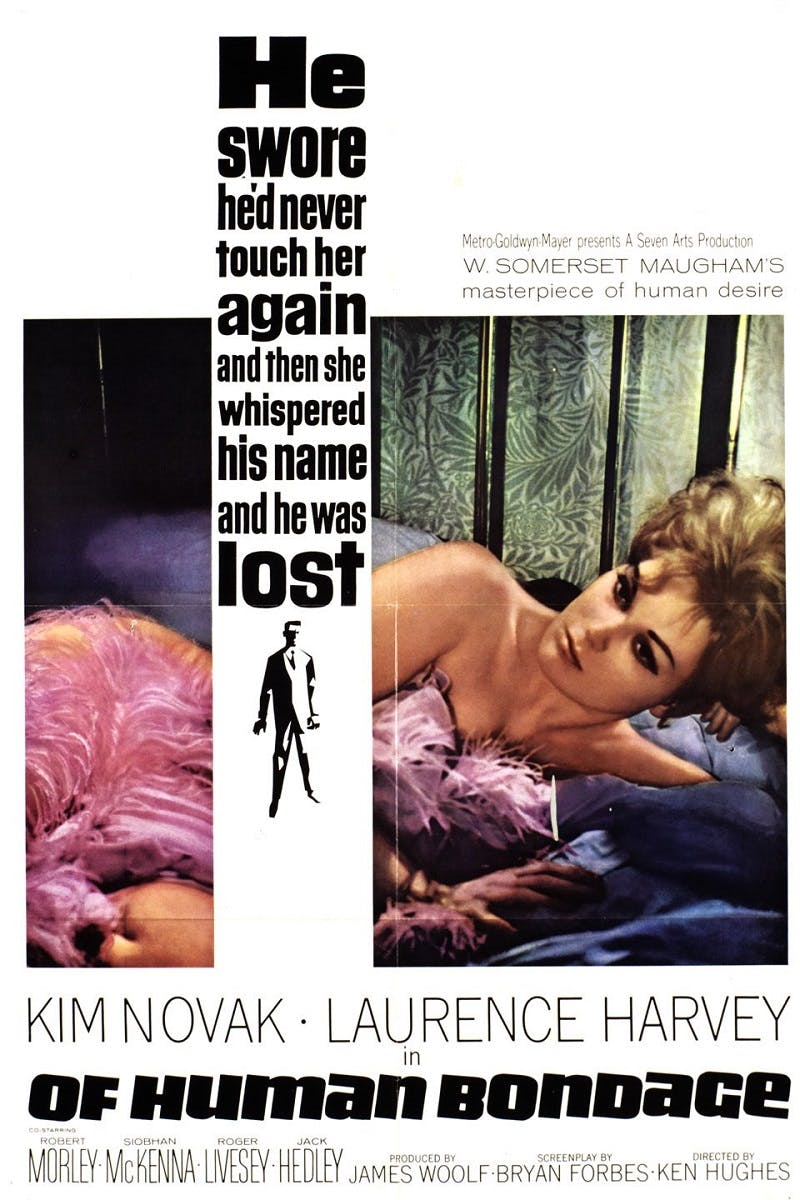
I much prefer William Boyd’s approach to the Bildungsroman in Any Human Heart and The New Confessions, both rare examples of pop fiction that stay with you after the final page. On the literary side, Michael Chabon’s The Amazing Adventures of Kavalier & Clay is hard to beat. You might place John Irving’s The World According to Garp in the middleground between them.
Now, Of Human Bondage isn’t devoid of substance. Several passages offer the reader something to reflect upon. One in particular stands out for the way it captures what a Bildungsroman is all about: He did not know how wide a country, arid and precipitous, must be crossed before the traveller through life comes to an acceptance of reality. It is an illusion that youth is happy, an illusion of those who have lost it; but the young know they are wretched, for they are full of the truthless ideals which have been instilled into them, and each time they come in contact with the real they are bruised and wounded.
Here, too, Philip’s realization conveys what we might expect the protagonist to pursue in a Bildungsroman: It seemed to Philip that there were three things to find out: man’s relation to the world he lives in, man’s relation with the men among whom he lives, and finally man’s relation to himself.
When Philip observes an elderly couple approaching the end of their story, it lands like a warning to the rest of us who are at various stages of our real-life Bildungsroman: Two quiet little people: they belonged to a past generation, and they were waiting there patiently, rather stupidly, for death; and he, in his vigour and his youth, thirsting for excitement and adventure, was appalled at the waste. They had done nothing, and when they went it would be just as if they had never been.
While I didn’t like the book overall, I most enjoyed Philip’s time in Paris, struggling to be an artist. He ultimately realizes and accepts that he will be nothing other than a second-rate artist and thus gives up his dream. Still, that section yielded three of my favorite quotes:
First on what a painter paints: A good painter had two chief objects to paint, namely, man and the intention of his soul.
Next on how a painter paints: We paint from within outwards—if we force our vision on the world it calls us great painters; if we don’t it ignores us; but we are the same. We don’t attach any meaning to greatness or to smallness. What happens to our work afterwards is unimportant; we have got all we could out of it while we were doing it.
And finally on what a painter captures: In Paris he had learned that there was neither ugliness nor beauty, but only truth; the search after beauty was sentimental. Had he not painted an advertisement of chocolat Menier in a landscape in order to escape from the tyranny of prettiness?
One passage stood up above all else. Several searches indicate that Maugham came up with this parable himself. Good work, old boy. The parable ultimately suggests that meaning changes over time and, really, that life is meaningless. But we must live on.
Philip remembered the story of the Eastern King who, desiring to know the history of man, was brought by a sage five hundred volumes; busy with affairs of state, he bade him go and condense it; in twenty years the sage returned and his history now was in no more than fifty volumes.
But the King, too old then to read so many ponderous tomes, bade him go and shorten it once more; twenty years passed again and the sage, old and grey, brought a single book in which was the knowledge the King had sought; but the King lay on his death-bed and he had no time to read even that, and then the sage gave him the history of man in a single line: it was meaningless whether he was born or not born, whether he lived or ceased to live. Life was insignificant and death without consequence.