Vineland
Thomas Pynchon
Thomas Pynchon defies narrative. He explores ideas through dozens of characters and sprawling plotlines, shifting from the Riemann Hypothesis to cartoon characters in the same paragraph. Each Pynchon novel tests the reader in a different way. Sometimes you’ll understand what’s happening. Other times you won’t. But you’ll find something beautiful, entertaining or thought provoking on every page.
Pynchon published Vineland 17 years after his award-winning masterpiece Gravity’s Rainbow. The book polarized critics. Some welcomed what they called “Pynchon lite.” Others were less generous. In a letter to a friend, David Foster Wallace said Vineland made it seem like Pynchon did nothing but smoke pot and watch cartoons for nearly two decades.
Filmmaker Paul Thomas Anderson ranks among Pynchon’s biggest fans. PTA turned Inherent Vice into a feature-length film and cited Vineland as the inspiration for One Battle After Another. He did that with Pynchon’s blessing, making him one of the very few people to have met the famously reclusive author.
With the exception of V, I’ve read all of Pynchon’s other work. I like Against the Day most of all followed by Mason and Dixon. While Vineland doesn’t cut close, I still enjoyed it and feel it’s a good entry point into Pynchon for the uninitiated. Instead of writing about the plot, I’ve highlighted a few of my favorite passages from the book. Like I said: Some are beautiful, others are entertaining and others still are thought provoking. I’ve categorized them accordingly.
Entertaining
Working in a corporate environment, the sentiment of this sentence feels all too familiar: It was bickering raised to the level of ceremony. (9)
A funny way to characterize and convey a character’s feelings: He looked old enough to’ve been through it before, but who knew, maybe this was his maiden voyage into the green seas of jealousy. (59)
Before joining The Sisterhood of Kunoichi Attentives, the character DL learned martial arts from a character called Inoshiro Sensei. Oh, the things she learned:
She learned how to give people heart attacks without even touching them, how to get them to fall from high places, how through the Clouds of Guilt technique to make them commit seppuku and think it was their idea — plus a grab bag of strategies excluded from the kumi-Uchi, or official ninja combat system, such as the Enraged Sparrow, the Hidden Foot, the Nosepicking of Death, and the truly unspeakable Gojira no Chumpira. Despite the accelerated schedule, some of the moves Inoshiro Sensei taught FL would only make sense ten years or more from now — requiring that much rigorous practice every day for her even to begin to understand — and until she did understand, she was forbidden to use any of them out in the world. (127)
In Jeffrey Eugenides’s Middlesex, Cal argues that feelings are too complex for single-word labels like "sadness" or "joy." He describes emotions as blended states, such as "the happiness that attends disaster." This line in Vineland made me think back to that idea from Middlesex: Ralph never thought of the look on his face as the helpless stare of an older man through a schoolyard fence, but as more the alert beaming of a micromanager. (132)
The increasingly relatable thought of an old man watching kids play through a schoolyard fence, reflecting on how quickly life passed and how far away youth seems, crushed me.
Animals and inanimate objects sometimes express themselves in Pynchon’s works. The episode of Byron the Bulb in Gravity’s Rainbow has been widely celebrated. Byron is an anthropomorphic eternal lightbulb who fights against the Phoebus cartel. The cartel controlled the manufacture and sale of incandescent light bulbs in much of Europe and North America between 1925 and 1939. It took over market territories and lowered the useful life of such bulbs, which is commonly cited as an example of planned obsolescence.
There’s nothing nearly as complex in Vineland, though this passage made me laugh out loud. DL gets kidnapped. Her car gets left behind, wondering where she went: They took her with a matter-of-factness that made her feel like an amateur. Her little car was left alone in its space, sometimes, across miles and years, to call out to her in a puzzled voice, asking why she hadn’t come back. (135)
Here Pynchon writes of a couple who fell in love under the influence and fell out back in reality: They’d been married, as a matter of fact, during a classical sixties acid trip, in which it became beyond clear to them both that in some other world they had been well acquainted. In this one, however, they only seemed programmed for unhappiness. One would find the other across a room and both would gaze awhile, sick with betrayal, remembering the deep and beautiful certainty beyond words, wondering why they should only have had a glimpse and where it might be now. (159)
The characters Frensi and DL were once part of a revolutionary guerilla film unit called 24fps. It makes me think of citizen journalists who capture some of what’s happening on the streets: They went looking for trouble, they found it, they filmed it, and then quickly got the record of their witness someplace safe. They particularly believed in the ability of close-ups to reveal and devastated. When power corrupts, it keeps a log of progress, written into that most sensitive memory device, the human face. Who could withstand the light? What viewer could believe in the war, the system, the countless lies about American freedom, looking into these mug shots of the bought and sold? (195)

Several passages in the book speak to the destruction that man has wrought on the environment. In this case, we get a fantastical story about parrots that adapted, especially amid the coming of humans and disappearing of trees:
They saw these birds, kept drunk and quiet on tequila for days, ranked out in front of the great ghostly eighteen-wheeler, bundles of primary color with hangovers, their reflections stretching and blooming along the side of the trailer. Soon there was scarcely a house in Vineland that didn’t have one of these birds, who all spoke English with the same peculiar accent, one nobody could identify, as if a single unknown bird wrangler somewhere had processed them through in batches — “All right, you parrots, listen up!” Instead of the traditional repertoire of short, often unrelated phrases, the parrots could tell full-length stories — of humorless jaguars and mischief-seeking monkeys, mating competitions and displays, the coming of humans and the disappearance of the trees — so becoming necessary members of households, telling bedtime stories to years of children, sending them off to alternative worlds in a replaced and upbeat set of mind, through after a while the kids were dreaming in landscapes that might have astonished even the parrots. (222)
Beautiful
You’ll find Pynchon’s most beautiful writing in his longer works, flashes of brilliance amid the chaos. While there are several in Vineland, I’ll call out just three short passages that were beautiful in different ways.
Here, I love the ideas that hidden structures or forces guide us through cities after sunset: He bounced from one Honolulu bar to another, allowing himself to trust to the hidden structure of night in a city, to a gift he sometimes thought he had for drifting, if not into intersections of high drama and significant fortune, at least away, most of the time, from danger. (61)
Inoshiro Sensei reflects on what he taught DL: This is what he felt he had to pass on — not the brave hard-won grace of any warrior, but the cheaper brutality of an assassin. (127)
And here, a comment on the irresponsibility and irrationality that overcomes peoplewho fall for one another: It was right at the steepest part of his curve of descent into irresponsibility, or, as he defined it at the time, love, with Frenesi Gates. (226)
Thought Provoking
One of the central tenets of narrative psychology is that we are the stories that we tell about ourselves. A passive stance would be to give into what the past has made of us. An active approach focuses instead of what we make of the past. I sometimes struggle to rewrite my own narrative. This passage resonated.
Sure, she knew folks who had no problem at all with the past. A lot of it they just didn’t remember. Many told her, one way and another, that it was enough for them to get by in real time without diverting precious energy to what, face it, was fifteen or twenty years dead and gone. But for Frenesi the past was on her case forever, the zombie at her back, the enemy no one wanted to see, a mouth wide and dark as the grave. (71)
Coming back to work—and everything else, really—this landed like a reminder that it’s hard to do anything if you don’t delude yourself into thinking it’s meaningful in some way: You’re supposed to allow yourself the illusion that what you do matters. (93)
Pynchonian paranoia in the computer age underpinned by commentary on God’s indifference to our existence:
If patterns of ones and zeros were “like” patterns of human lives and deaths, if everything about an individual could be represented in a computer record by a long string of ones and zeros, then what kind of creature would be represented by a long string of lives and deaths? It would have to be up one level at least — an angel, a minor god, something in an UFO. It would take eight human lives and deaths just to form one character in this being’s name — its complete dossier might take up a considerable piece of the history of the world. We are digits in God’s computer, she not so much thought as hummed to herself for, to be dead or living, is the only thing He sees. What we cry, what we contend for in our world of toil and blood, it all lies beneath the notice of the hacker we call God. (91)
At the The Sisterhood of Kunoichi Attentives, the Head Ninjette tells DL’s partner a story about the Garden of Eden. I confess that I used AI to analyze this passage. The key takeaway here is that the Ninjette’s story reframes part of Genesis as a powergrab. Eden isn’t “fallen” by women; it’s rewritten by men. Power enters history by rewriting origins. Control begins by naming, sorting, and moralizing. And once a system creates damage, it assigns a caretaker. It’s an interesting analysis that brings to mind the rewriting of history in America right now.
This is important, so listen up. It takes place in the Garden of Eden. Back then, long ago, there were no men at all. Paradise was female. Eve and her sister, Lilith, were alone in the Garden. A character named Adam was put into the story later, to help make men look more legitimate, but in fact the first man was not Adam — it was the Serpent.
I like this story, said Takeshi, snuggling into his pillow.
It was sleazy, slippering man, Rochelle continued, who invented good and evil, where before women had been content to just be. In among the other confidence games they were running on women at the time, men also convinced us that we were the natural administrators of this thing “mortality” they’d just invented. They dragged us all down into this wreck they’d made of the Creation, all subdivided and labeled, handed us the keys to the church, and headed off toward the dance halls and the honky-tonk saloons. (166)
One of my favorite passages of the books comes when Vato and Blood — characters who sing a parody version of the Chip n’ Dale theme song using their own names — pass through a sacred area where the Yurok Native American tribe once lived. The Yuroks were different from other Native American tribes in interesting ways. For instance, Yurok doctors were almost exclusively women; in other tribes, men tended to hold such positions.
Here, we learn about the woge — prehuman, immortal spirits who created the world, established culture, and invented medicine, but left for the high country or ocean when humans arrived:
They took the North Spooner exit and got on River Drive. Once past the lights of Vineland, the river took back its older form, became what for the Yuroks it had always been, a river of ghosts. Everything had a name — fishing and snaring places, acorn grounds, rocks in the river, boulders on the banks, grooves and single trees with their own names, springs, pools, meadows, all alive, each with its own spirit. Many of these were what the Yurok people called woge, creatures like humans but smaller, who had been living here when the first humans came. Before the influx, the woge withdrew. Some went away physically, forever, eastward, over the mountains, or nestled all together in giant redwood boats, singing unison chants of dispossession and exile, fading as they were taken further out to sea, desolate even to the ears of the newcomers, lost. Other woge who found it impossible to leave withdrew instead into the features of the landscape, remaining conscious, remembering better times, capable of sorrow and as seasons went on other emotions as well, as the generations of Yuroks sat on them, fished from them, rested in their shade, as they learned to love and grow deeper into the nuances of wind and light as well as the earthquakes and eclipses and massive winter storms that roared in, one after another, from the Gulf of Alaska.
For the Yuroks, who had always held this river exceptional, to follow it up from the ocean was also to journey through the realm behind the immediate. Fog presences glided in coves, dripping ferns thickened audibly in the gulches, semivisible birds called in nearly human speech, trails without warning would begin to descend into the earth, toward Tsorrek, the would of the dead. Vato and Blood, who as city guys you would think my get creeped out by all of this, instead took to it as if returning from some exile of their own. (186)
Speculation about which book(s) on Yurok mythology Pynchon has on his shelf often points to the work of Erik Erikson who studied the Yurok people in Northern California alongside anthropologist Alfred Kroeber to link cultural settings with childhood training patterns. I cannot access Erikson’s work, but I do have Kroeber’s book, Yurok Myths, which likely provides the basis for the story of the woge told while Vato and Blood are driving. From Kroeber:
The woge are small humanoid beings who reluctantly yielded the earth to mankind. There is an eerie sense of nostalgic sadness and loss whenever the woge are mentioned in Yurok myths. Inevitably, the woge withdrew into the mountains or across the sea or turned into landmarks, birds, or animals in order to escape close contact with newly created man. Yet the woge are still present in some sense, and they are depicted as being glad to be called upon (in ritual formulas and the like).
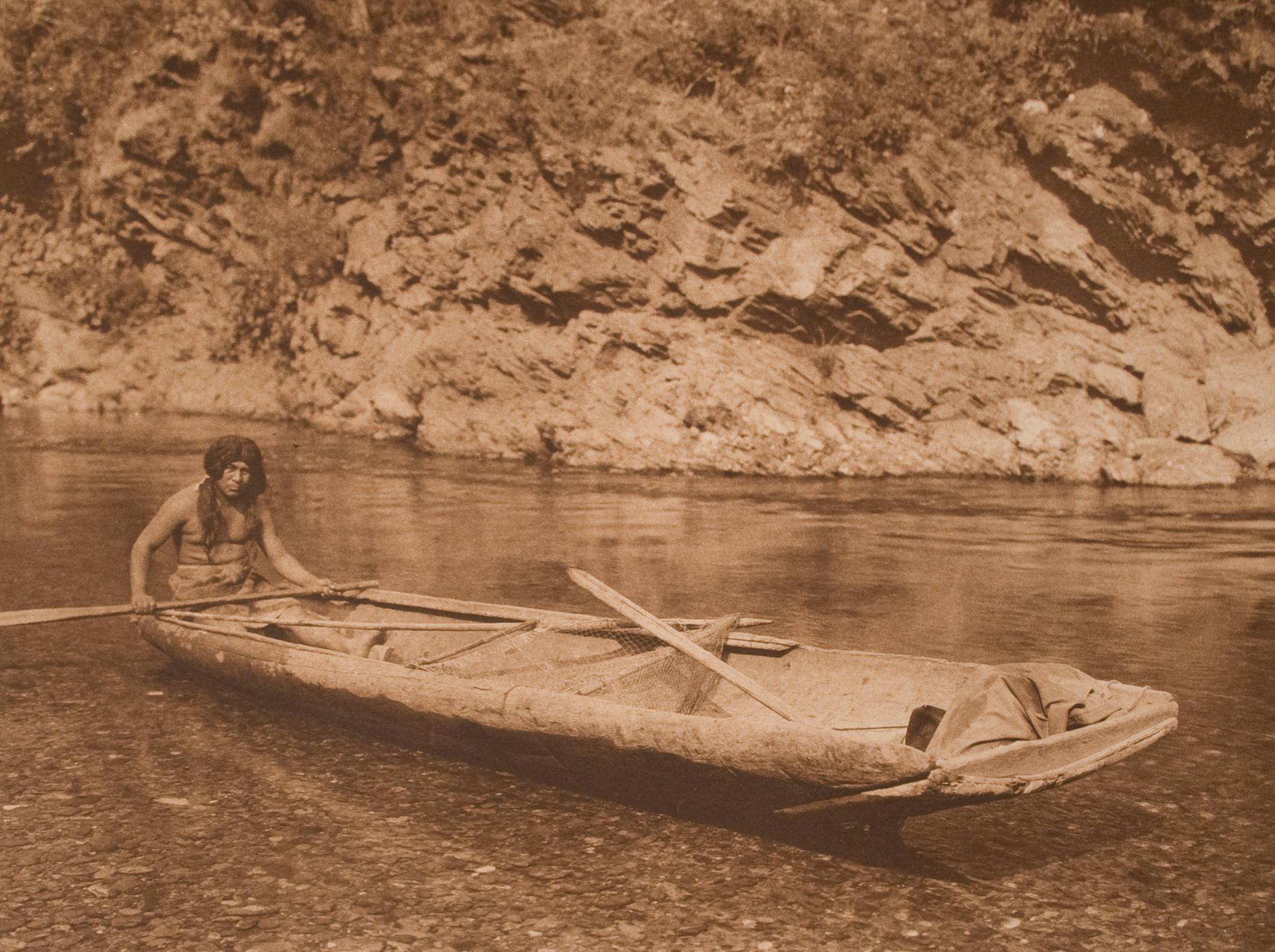
Near the end of the book, there’s another reference to Yurok mythology. A bit of desk research yields the following details on how the Yuroks thought of the dead: The dead were thought to go "below" where the dead Yurok had to cross a river on a boat. If the boat tipped over, the corpse was revived on earth. Once the river had been crossed, however, return was impossible. The dead were ascribed to three types of afterlife: those killed by weapons went to "the willows," forever dancing and shouting in a war dance; thieves and "contentious" persons went to an "inferior place"; and a rich, peaceable man went to "the sky."
In Vineland, Pynchon blends Yurok mythology with his own imagination, inviting us to imagine what happens if the boat were smashed: As he drove, Vato told an old Yurok story about a man from Turip, about five miles up Klamath from the sea, who lost the young woman he loved and pursued her into the country of death. When he found the boat of Illa’a, the one who ferried the dead across the last river, he pulled it out of the water and smashed out the bottom with a stone. And for ten years no one in the world died, because there was no boat to take them across. (379)
What a way to end.