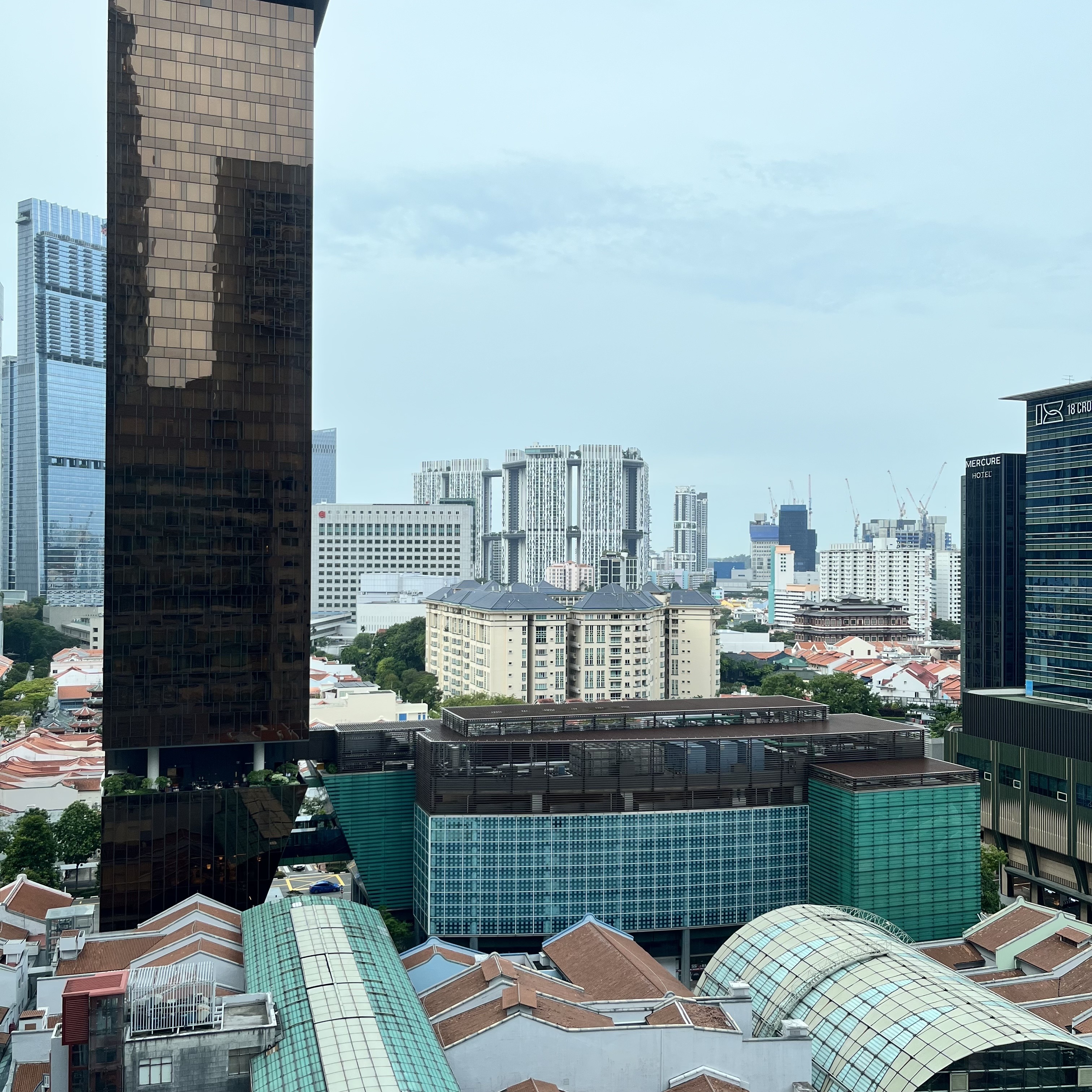
The View from Home
I walk to work. It’s a nice way to start the day. Door to door, the walk takes 14 minutes at a New York pace. Singapore sits about one degree of latitude north of the equator. We get a tropical rainforest climate year-round. Put another way, it’s fucking hot. And the humidity is punishing. I leave my apartment at 6:40 a.m. to beat the worst of it and make the return trip after sunset. Here’s the view from my window right before setting off. You can see our office. Between the skyscrapers in the distance there’s a much smaller building with a slanted roof. That’s the place. My neighborhood is called Tanjong Pagar. Before Singapore was Singapore, the neighborhood was called Salinter, which means “cape of stakes.” It was a fishing village. The main road that cuts through town was the shoreline. Its transformation into a major port area was driven by the opening of docks in the 1860s, which attracted a large population of dockworkers, rickshaw pullers and immigrants. In 1989, the government designated Tanjong Pagar a conservation area, part of Singapore’s first major gazettement of historic districts. The structure of the orange-roofed shophouses in the foreground, for instance, cannot be modified.


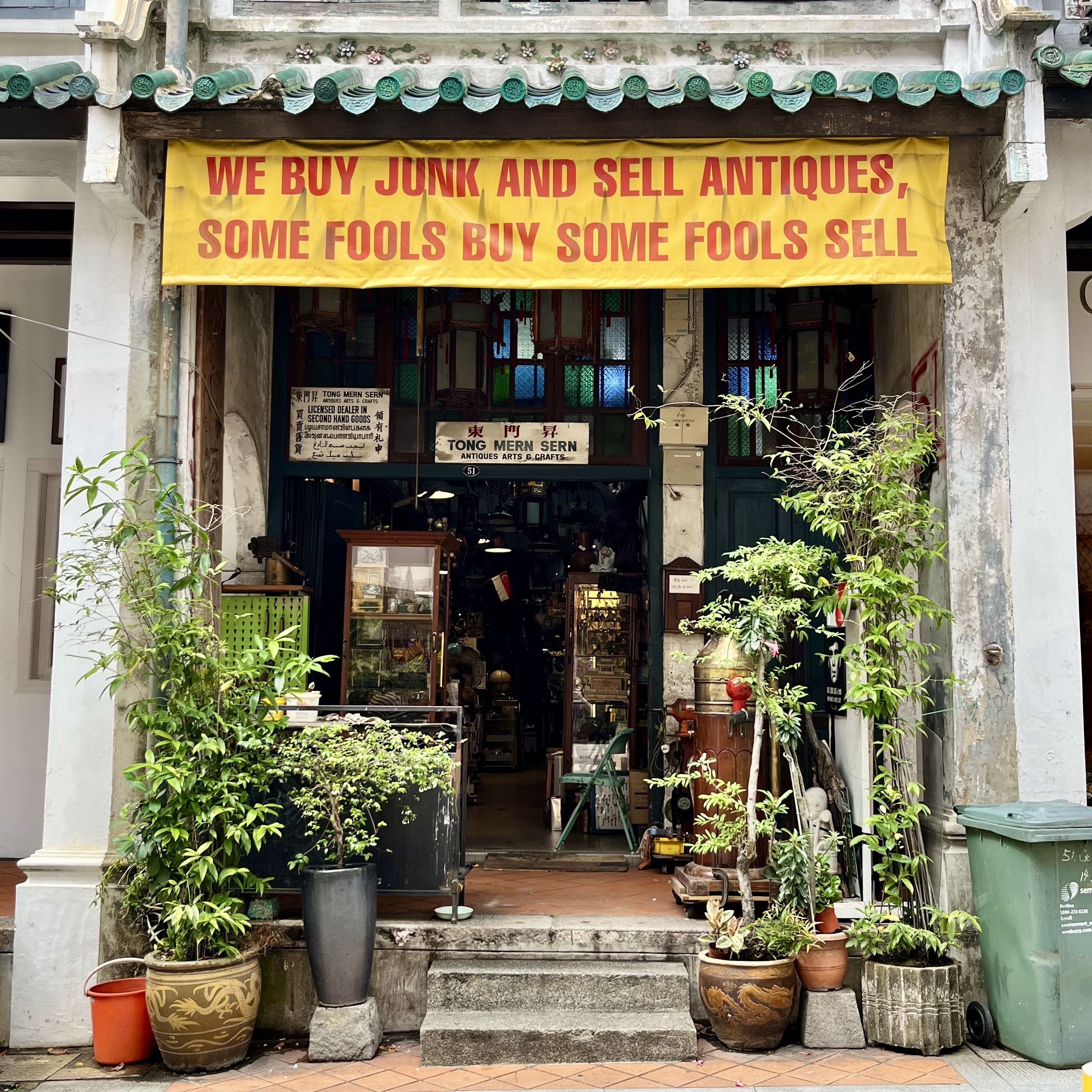
The Antique Shop
The antiques shop across the street is the first thing I see during my walk. It’s called Tong Mern Sern. Keng Ah Wong opened the shop in 1972 and runs it today with his daughter. You can find all sorts of crap there: pottery, clocks, records, instruments, nautical equipment, a framed collage of John Travolta for some reason, stacks of National Geographic. The magazines are great. One of my favorite gifts to give on someone’s birthday is an old magazine from the year and month they were born. Tong Mern Sern makes that easy. The sign above the entrance reads: “We buy junk and sell antiques. Some fools buy, some fools sell.” Tourists and locals love taking photos of that sign, though few venture inside. Perhaps because there’s something intimidating about Keng’s gaze. He usually sits in that seafoam green folding chair at the front of the shop. It’s the only thing that’s not for sale.


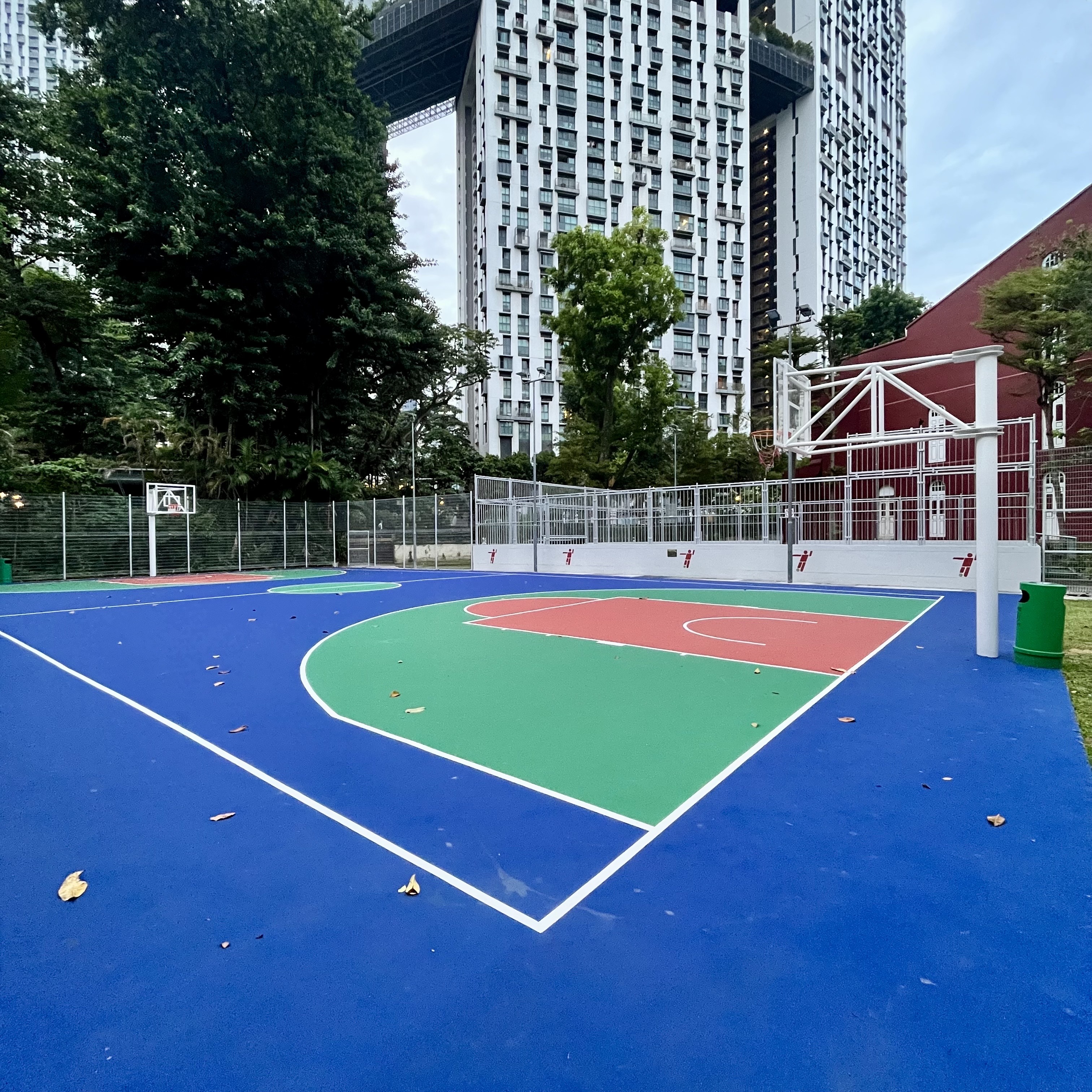
The Basketball Court
There’s a beautiful basketball court beside the antique shop. The court was refurbished this year as part of the Tanjong Pagar Town 5-Year Plan running through 2030. According to Joan Pereira, the Member of Parliament for Tanjong Pagar Group Representation Constituency, “Our vision is to build a neighbourhood that brings residents closer together, fostering stronger bonds and closer relationships in our community.” Most people play basketball in the evening. You’d die of heat stroke during the day. I sometimes watch people play and can assure you that nobody in the neighborhood will make it to the NBA. The best basketball I saw there was a pick-up game with two Mormon missionaries. Kid you not, they wore their ties and name badges throughout the game. Everyone found it funny, but the Mormons crushed it, behind-the-back passing and all.


Bengal Lancer Painting
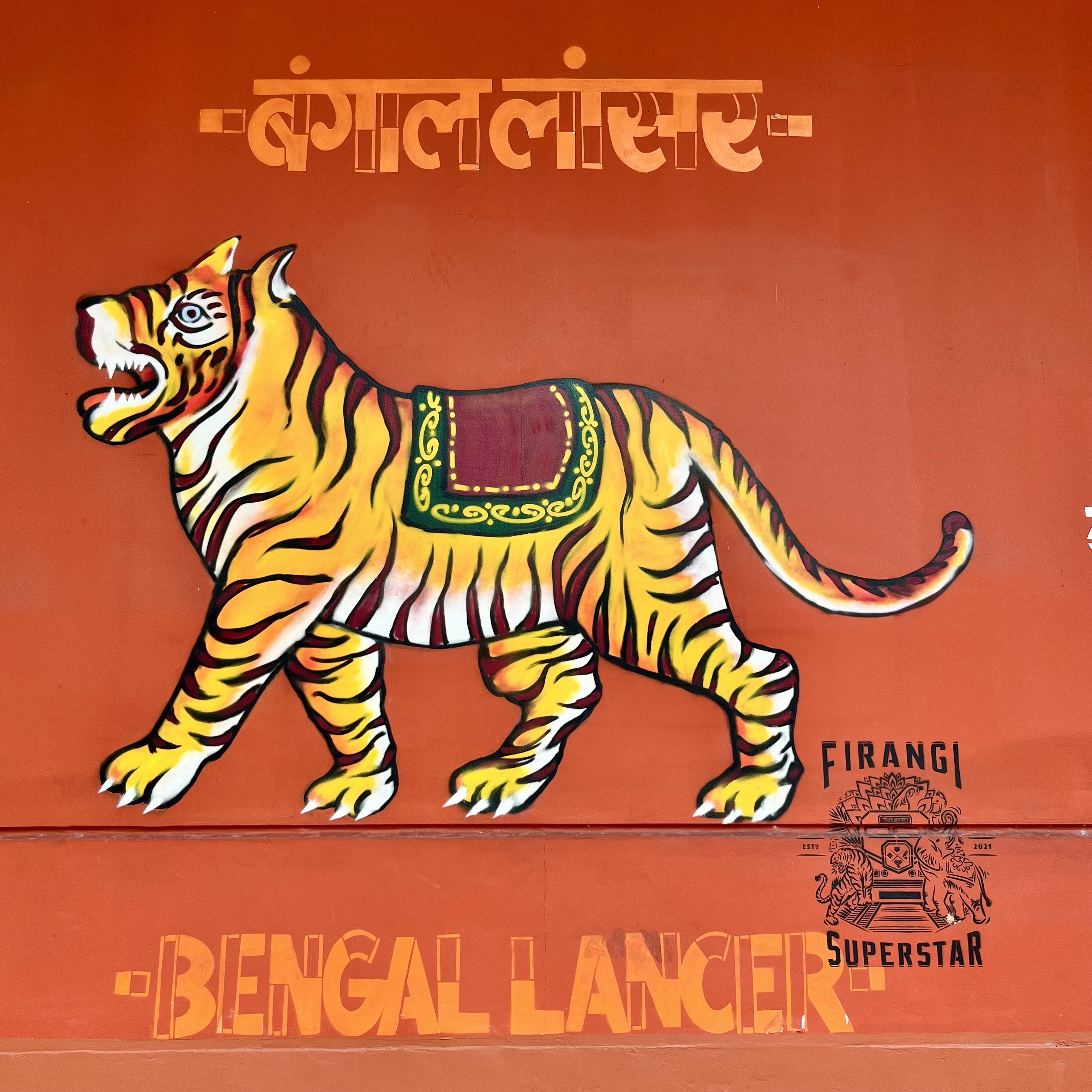
A few steps further on my side of the street, there’s a painting of a tiger outside the Indian restaurant Firangi Superstar. The words “Bengal Lancer” below the tiger refer to historic cavalry regiments of the British Indian Army, known for their role in colonial conflicts. The term also shows up in modern Indian and Bangladeshi military units, in popular culture and in Indian restaurants named in their honor. Bengal Lancers were elite, often irregular, horsemen who were crucial to British military power in India, with legacies that continued in post-colonial armies. The words above the tiger present a phonetic rendering of “Bengal Lancer” in Devanagari script.


Iron Artwork
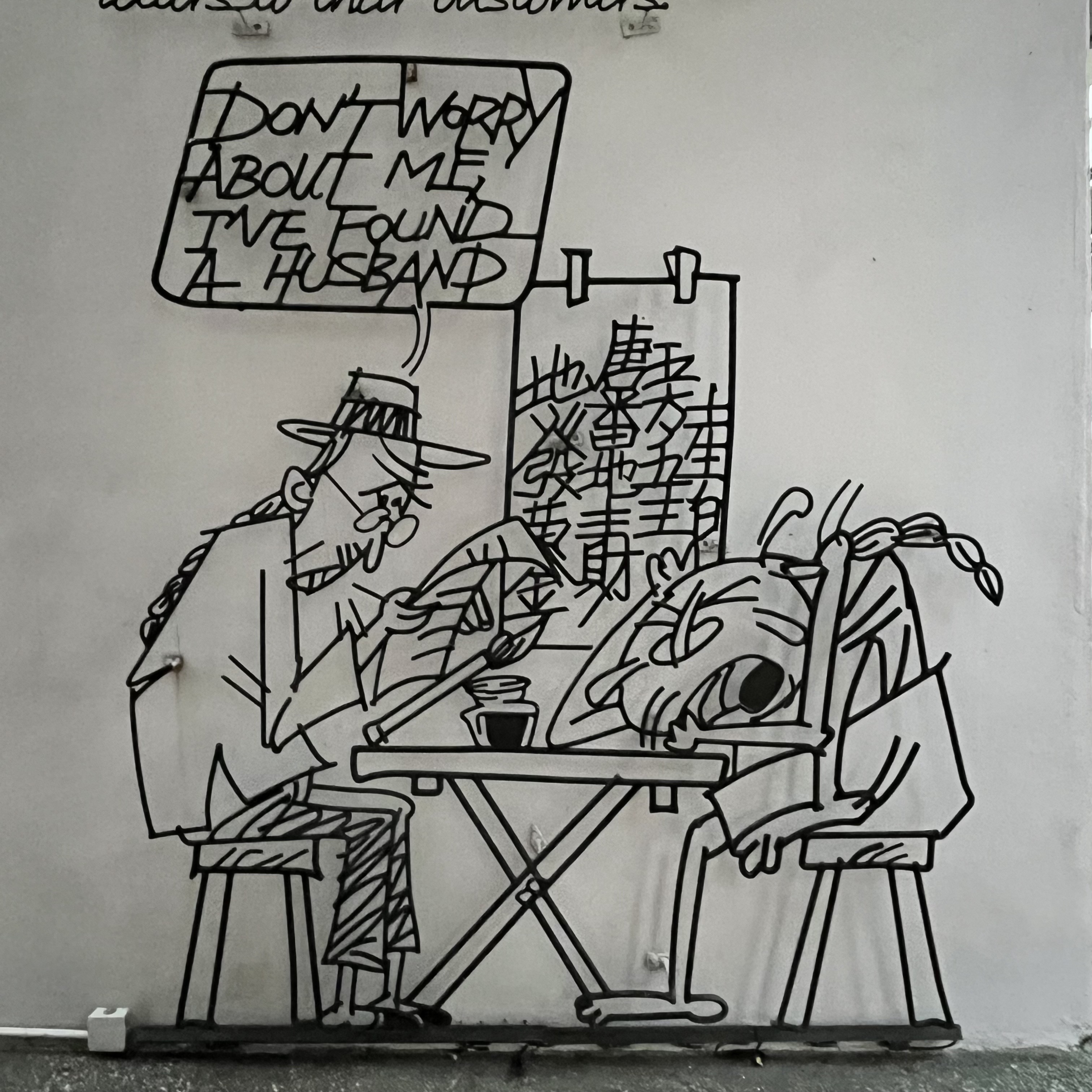
Just beyond the tiger, there’s a small alleyway where my building keeps its recycling bin. Along this wall are several iron sculptures created by the Malaysia-based collective SCULPTUREATWORK. The tongue-in-cheek sculpture pictured here depicts an old trade once common across Singapore: the letter writer. Before widespread literacy, people relied on professional scribes to read incoming letters and write replies on their behalf. It was an intimate service. The writer often became the bridge between families, lovers or employers separated by distance. In this piece, the character on the left reads aloud from a letter: “Don’t worry about me, I’ve found a husband.” The character on the right, head in hands, has received unexpected news. The Chinese characters behind them are stylized and intentionally messy, echoing the look of old fortune-telling or matchmaking boards. They roughly translate to: - 姻緣 — Romance / marriage prospects - 事業 — Career - 財運 — Wealth / financial luck - 風水 — Feng shui / energies of the home The board functions like a traditional fortune-teller’s menu of services.


Shepard Fairey Mural
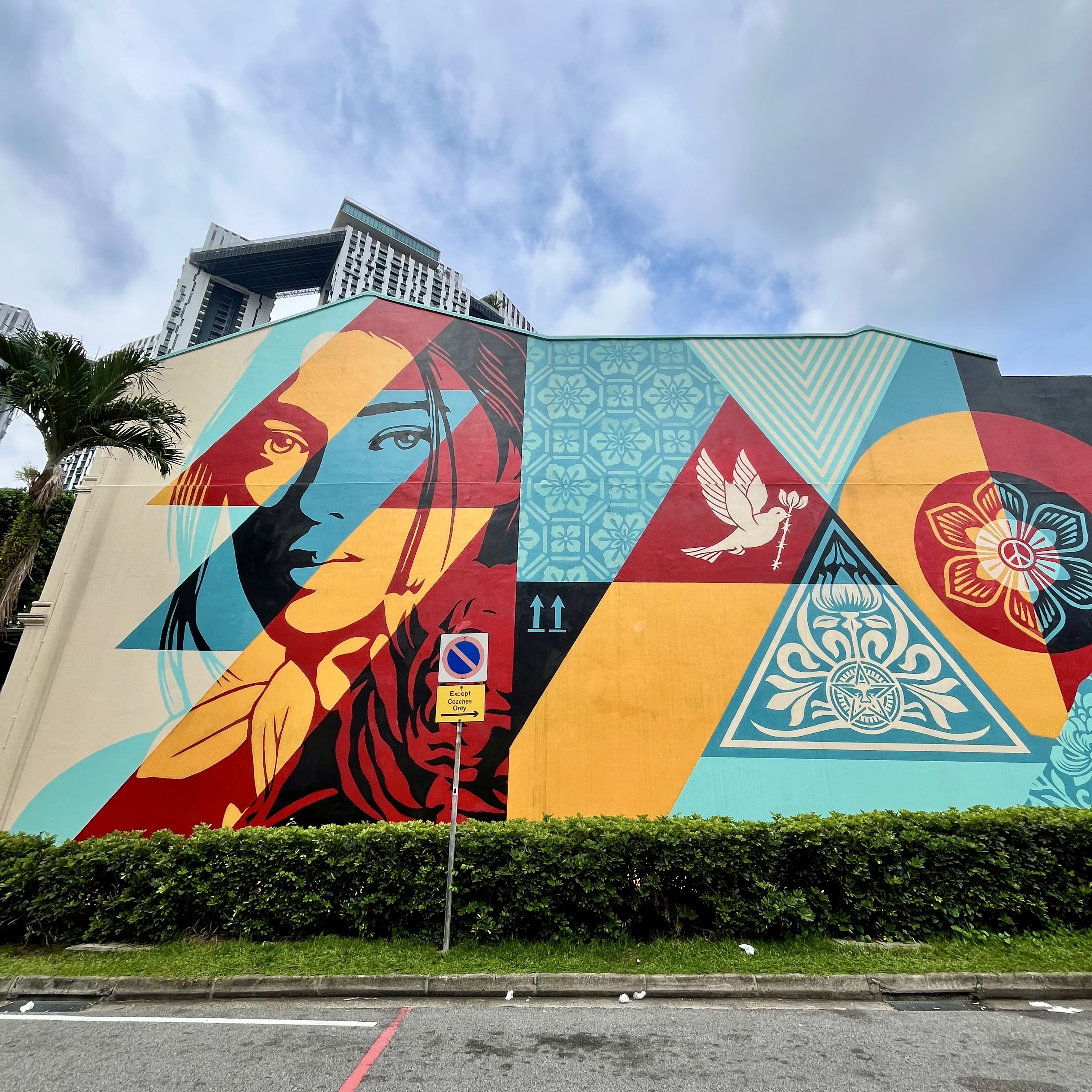
Twenty steps up the block we find a large mural by the American artist Shepard Fairey. The mural went up in 2023. An object label on the wall tells us this: “The artwork by American contemporary artist Shepard Fairey symbolizes peace and resilience through powerful imagery of three icons centered around a flower, including a dove carrying one fashioned from barbed wire. Representing the people of Singapore and their pursuit of harmony, the piece blends bold colors and a patchwork composition inspired by punk-rock and skate culture. Asian-inspired motifs add depth to the design, inviting viewers to reflect on their role in nurturing peace within their communities and beyond.” A few observations: some of the geometric patterns reflect Peranakan tilework and batik patterns from Malay and Indonesian culture. The image of a dove carrying a flower made from barbed wire is painted in red and white, the colors of the Singapore flag. Singapore views itself as a safe, orderly, highly stable crossroads in a turbulent region. I’m not sure what the two blue arrows mean, but they seem to point to the building rising above behind it. The Pinnacle@Duxton is one of Singapore’s most celebrated public housing icons, a pet project of Singapore’s late founder Lee Kuan Yew and a symbol of progress, innovation and community.


Tanjong Pagar Road
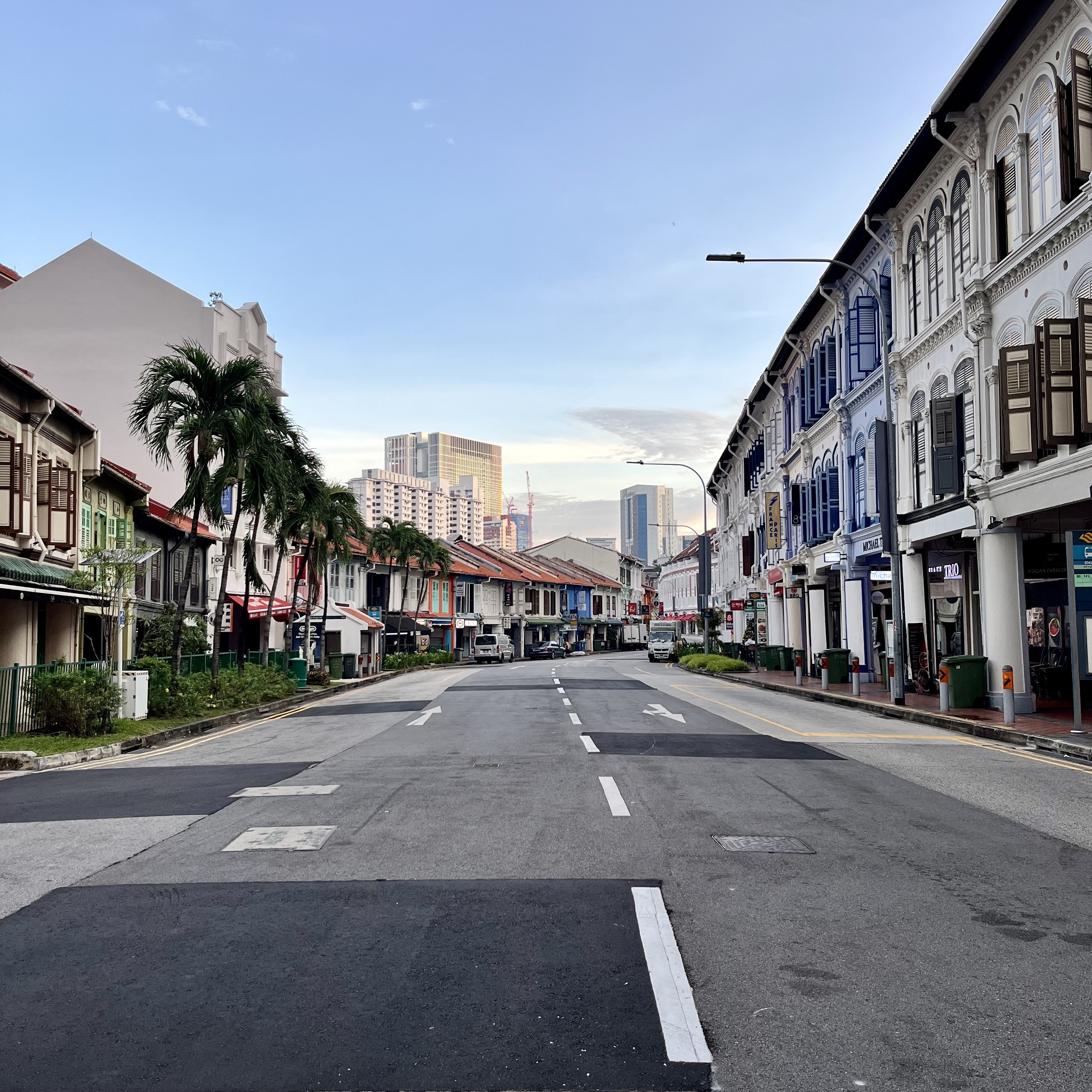
Tanjong Pagar Road was officially opened on 2 July 1892 by then Governor of the Straits Settlements, Cecil Clementi Smith. It became one of the main thoroughfares for the transportation of goods between the docks and godowns (warehouses) along the Singapore River. Today, restaurants line the road. Singapore tends to cluster things of a kind. Where you find one camera shop you’ll find a dozen. Where you find one guitar shop, you’ll find ten more. Tanjong Pagar Road clusters Korean restaurants and shops selling bridal gowns.


Shin Terroir Izakaya
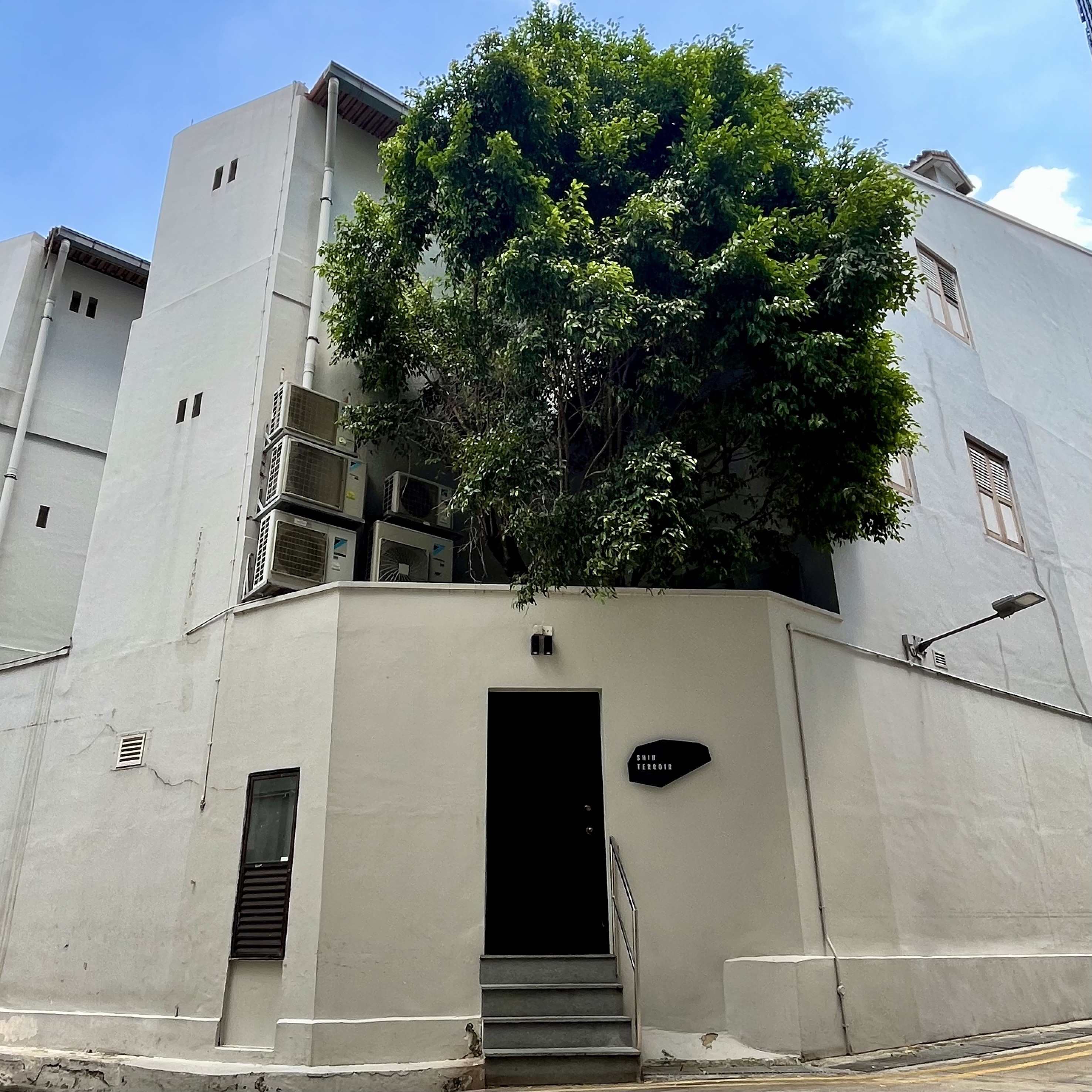
Cutting through a pedestrian alley further along, there’s a 10-seat yakitori bar called Shin Terroir. Patrons enter through a dodgy door in the alley. Inside, they pay $200 per person for a fixed course. Too expensive for me. While I’ve never been there, I love that there’s a tree on the roof above the entrance.

Maxwell Chambers
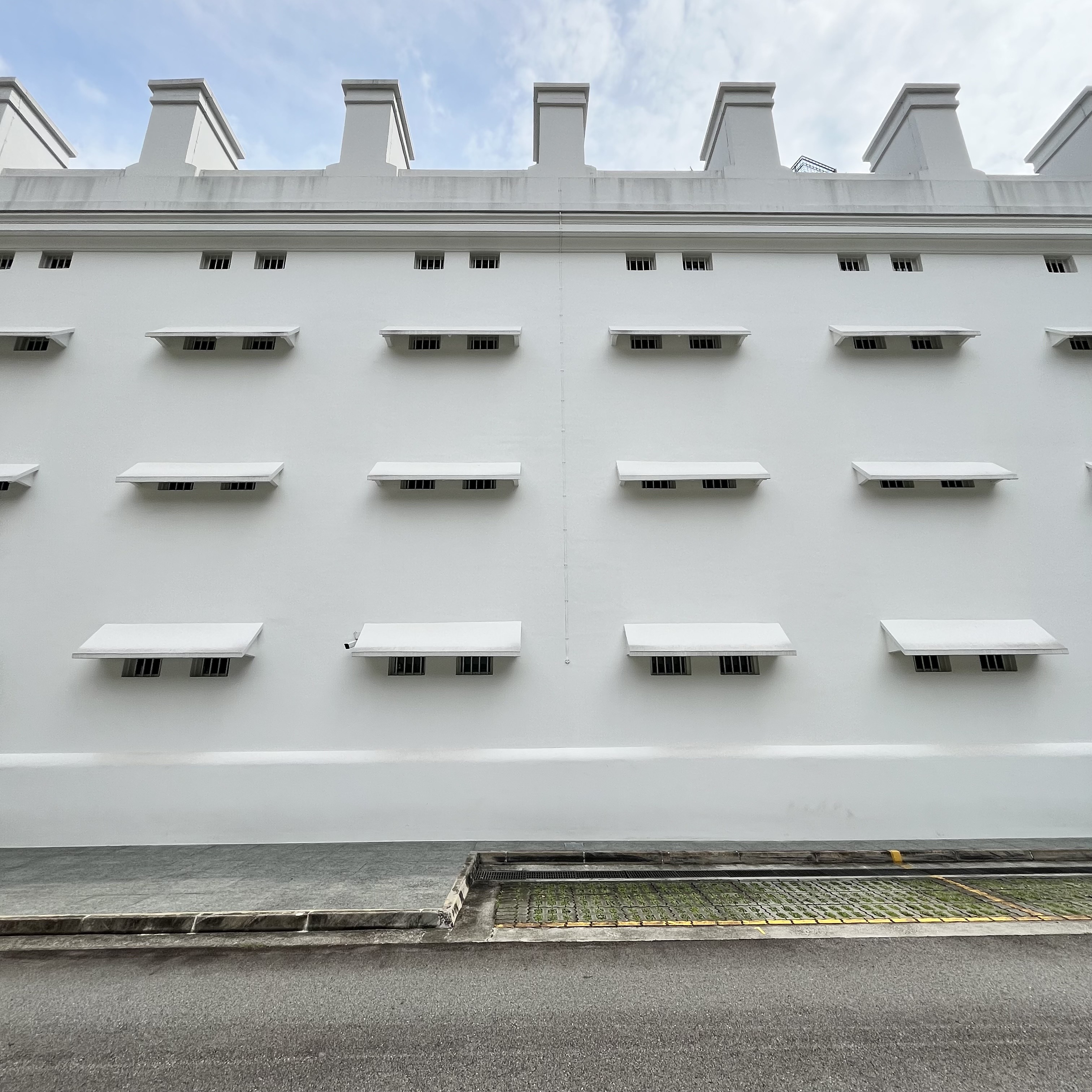
Around a third of the way to the office I pass Maxwell Chambers. The site consists of two buildings, both built in 1932 during the British colonial era. The former Custom House building at 32 Maxwell Road served as the headquarters of the Department of Customs and Excise from 1932 to 1989. From the late 1940s to the 1970s, the Custom House was used as a base to suppress the smuggling of contraband and drugs, as well as the illicit distillation of liquor. Even back then Singapore didn’t fuck around. During the Japanese Occupation of Singapore, the building became a place of refuge for expatriate customs officers and their families who had escaped from Malaya. It also sheltered Australian soldiers who were rescued after being attacked by Japanese troops. The building at 28 Maxwell Road was built toward the end of the 1920s and was first used as a police barracks until the Traffic Police Headquarters moved there in January 1930. The Traffic Police Headquarters remained there for almost 70 years until 1999. The building also used to house Singapore’s first driving test centre. Today, Maxwell Chambers is an international arbitration center.
Tanjong Pagar Park
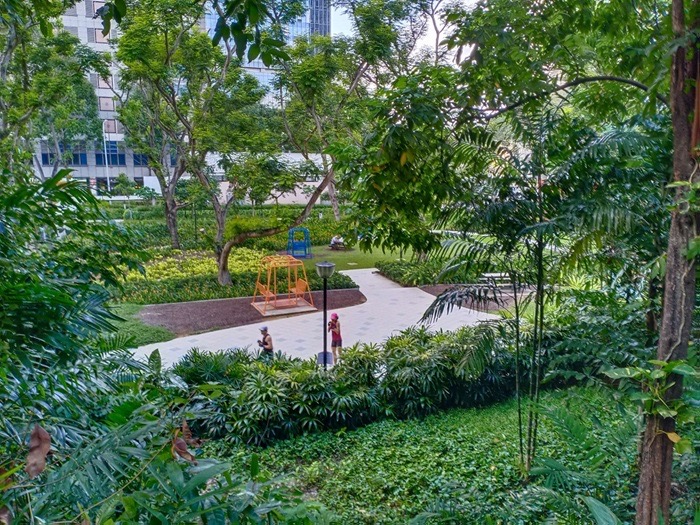
Across the street we reach Telok Ayer Park. The park is currently being refurbished, so I pulled this photo from the park’s website. This lush little park bordering the central business district offers Angsana trees, Tembusu trees and spice trees such as tamarind, cinnamon, nutmeg and breadfruit. A few years ago, I felt something fall on my shoulder in this park. I thought it was a berry. I searched the ground for it to no avail. Then I felt the weight on my shoulder. It wasn’t a berry; it was a grasshopper. In Kung Fu, Shaolin Master Po called Kwai Chang Caine “grasshopper” after a lesson where the boy couldn’t hear the grasshopper at his feet, teaching him to be more attuned to his surroundings. I was like Caine at that moment. Now, in some cultures a grasshopper on the shoulder is a sign of good luck. I didn’t learn that growing up in Massapequa. So I followed my instinct: swat the grasshopper and scream like a little girl. I mean, the fucker was bigger than a hummingbird. What would you do? The grasshopper shot off into the bushes like a heat-seeking missile. The wingbeats were audible from at least a half mile away. I think about that when I walk through the park sometimes. Is it still there, waiting?

Chinese Methodist Church
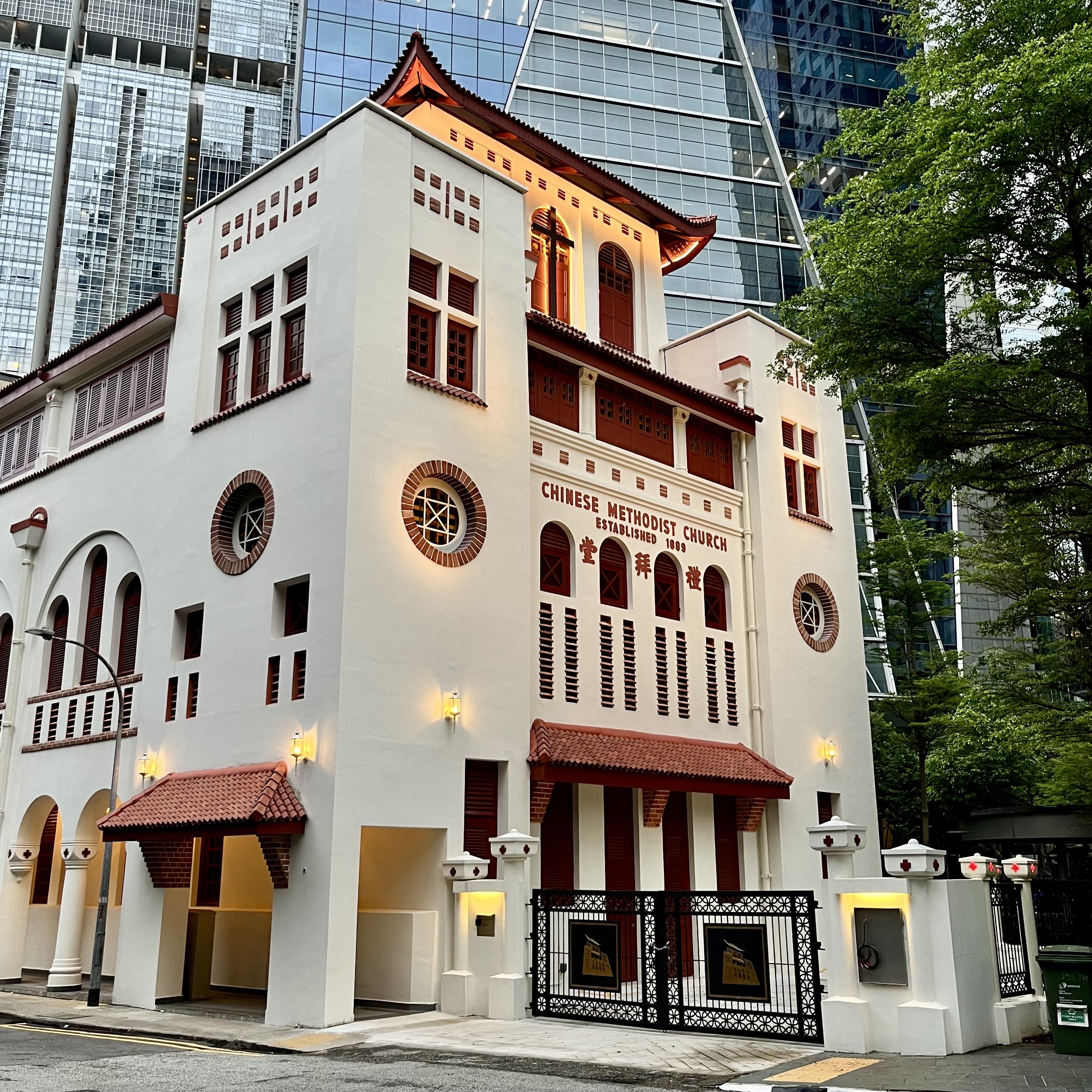
A Chinese Methodist church stands across from the hawker centre. While its roots tie back to the Methodist pioneer missionary Dr. Benjamin West, who preached from a shophouse as early as 1889, the church was built in 1925. West brought Western religious ideology to the East. Today, the church offers services in Mandarin. The architecture firm Swan and Maclaren built the church. They’re still in business. A few notes on how the design brings together multiple influences: the pagoda roof over the main block is one of the striking Chinese features of the church. The louvred doors and windows are reminiscent of those found in Southeast Asia. The church also features a distinctly Malayan five-foot walkway on the west side that links it to adjoining shophouses. Byzantine-style columns and piers, marked with crosses, stand along the length of the walkway. The Western influences of the building’s architecture are reflected in the location of the sanctuary on the second level, a common European practice for urban churches of that period. The Roman-style rectangular block, with its two towers on either side, is also considered Western in origin.
Amoy Street Food Centre
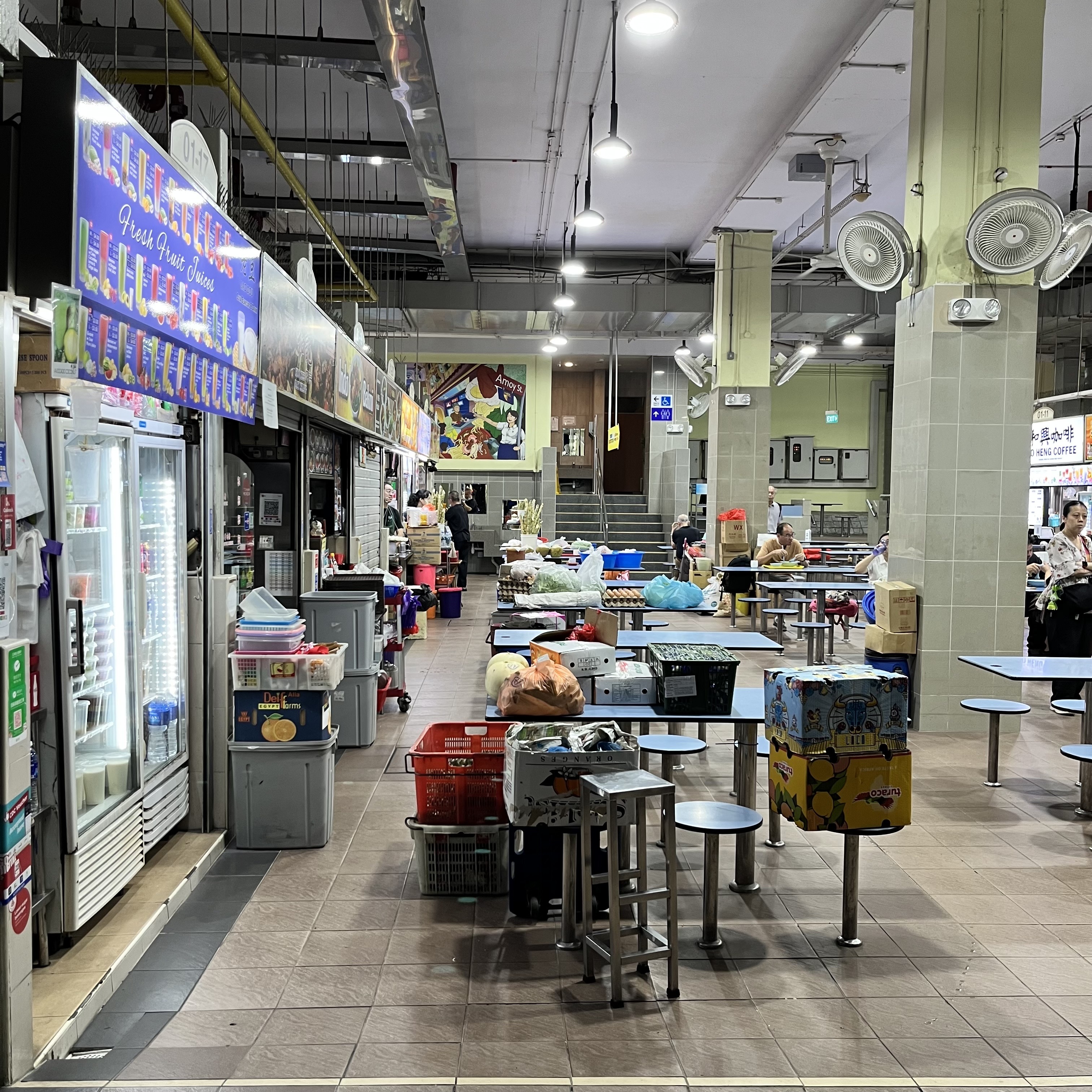
The park lets out near Amoy Street Food Centre, a two-storey hawker centre at the junction of Telok Ayer Street and Amoy Street. The centre opened in 1983 amid a government drive to relocate street hawkers into proper facilities, replacing informal setups from the 1950s and serving the growing office crowd with affordable local food. Originally housing relocated hawkers from nearby streets like Amoy, Stanley and Telok Ayer, it quickly became a bustling spot known for its blend of classic heritage stalls and newer establishments, evolving into a culinary landmark with Michelin-recognized vendors. In the morning, Amoy Street Food Centre is a popular destination for cyclists. They ride anywhere from 30 km to 100 km in large groups and come here to refuel afterwards. Lunch crowds pack into the hawker centre during the afternoon. While the food is great, the lack of air conditioning makes this a better destination for dinner.

My Awesome Cafe
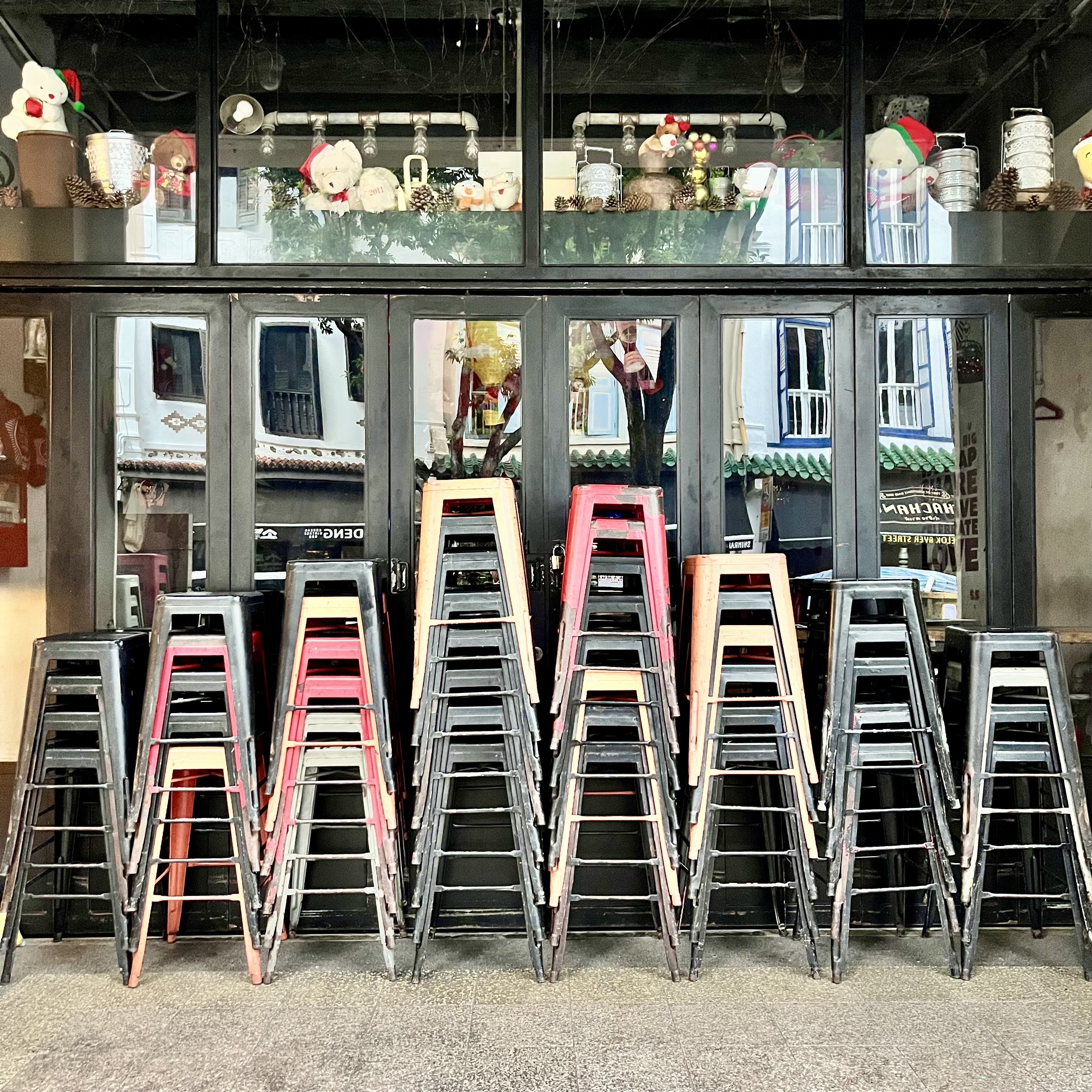
My Awesome Cafe marks the halfway point of my walk to work. I hate this place. It’s an overpriced cafe where expats swill beer after work. It’s the primary reason why I walk on the other side of the street on the journey home. I must admit, they do a good job stacking those shoddy stools. If only it were always like that.
Al-Abrar Mosque
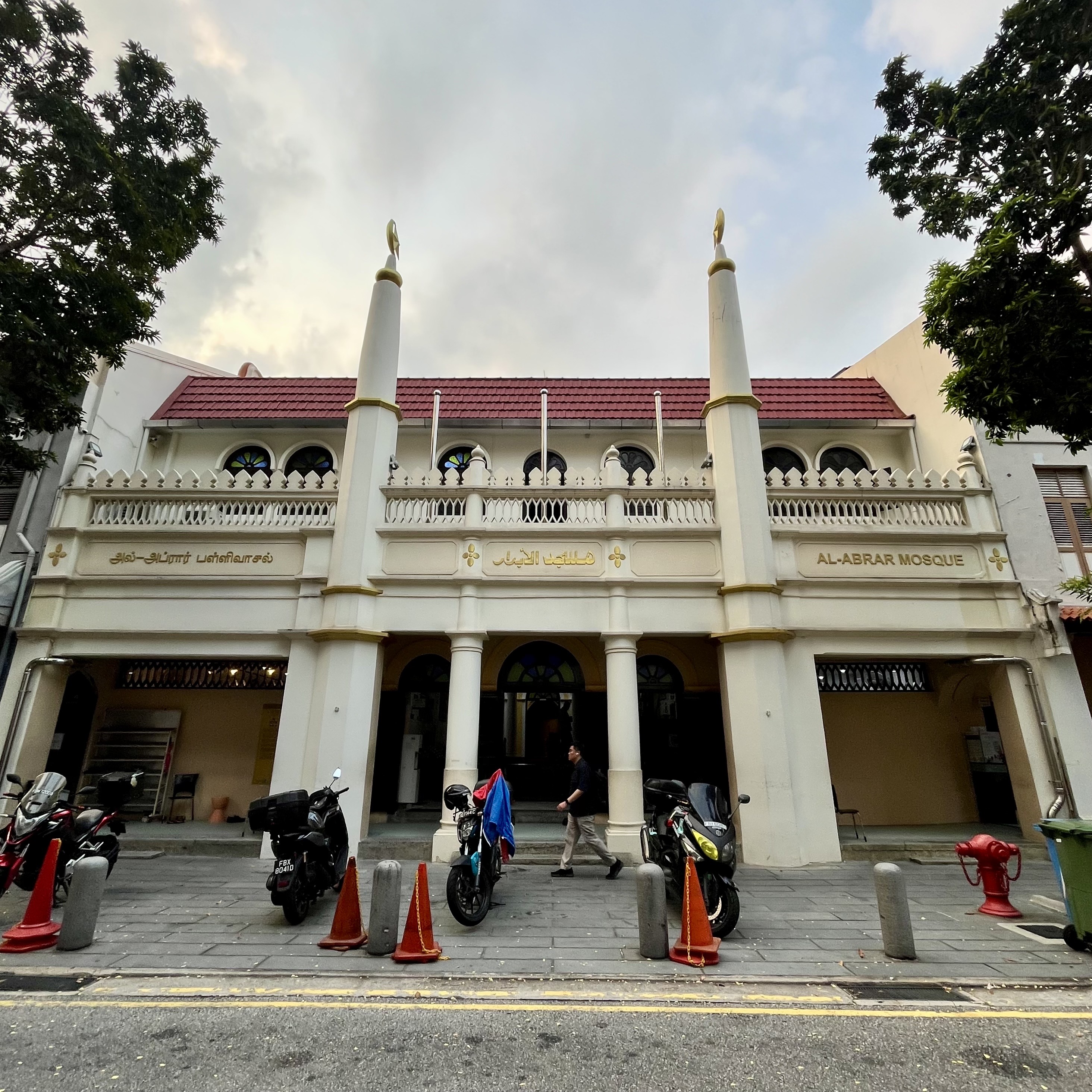
We quickly reach the second religious structure on this trip: Al-Abrar Mosque. Founded in 1827, Al-Abrar Mosque began as a small thatched hut, which quickly earned its nickname Kuchu Palli (“Hut Mosque” in Tamil). It catered mainly to the Chulias, who hailed from the Coromandel Coast in South India and were mostly traders and moneychangers. Construction of the present brick mosque commenced in 1850 and finished in 1855. The mosque underwent a series of major renovations between 1986 and 1989, adding a second floor and a large jack roof to enlarge the prayer hall. Al-Abrar Mosque continues to serve a largely Indian Muslim congregation today. Many Muslims from other ethnic communities who work in the offices nearby also worship at the mosque, especially on Fridays.

Thian Hock Keng Doors
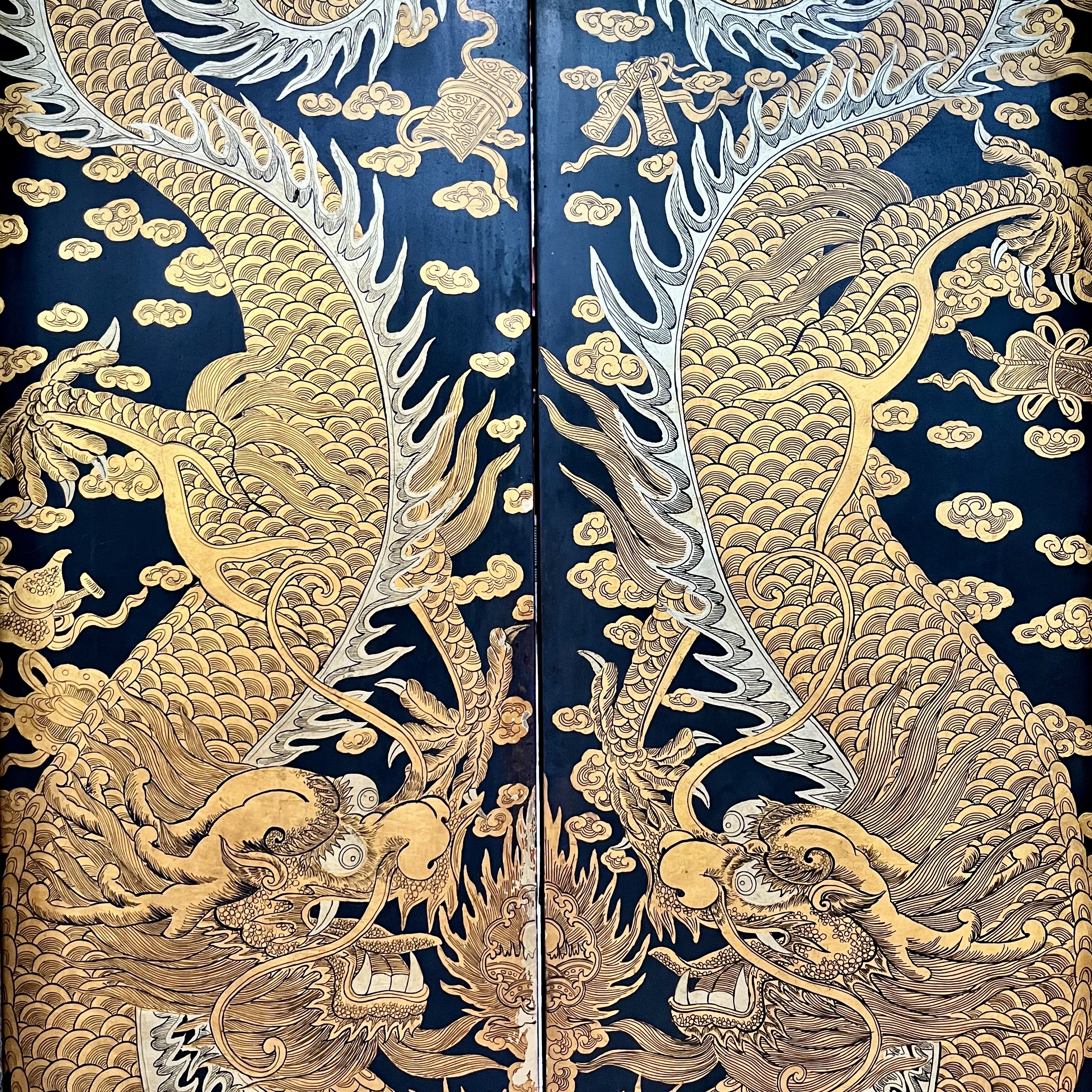
These are the dragon doors of Thian Hock Keng, one of Singapore’s oldest and most important Hokkien temples. The temple was completed in 1842 and dedicated to Ma Zu, the sea goddess who protected early Chinese migrants during their voyages to Singapore. The doors are a masterpiece of southern Chinese craftsmanship, carved and gilded using traditional methods. On them, two dragons coil upward in symmetrical opposition, their bodies rendered in dense repeating scales and flame-like tendrils. This composition of two dragons facing each other is known as 雙龍戲珠, “Two Dragons Playing with the Flaming Pearl.” Thian Hock Keng was built entirely without nails, using traditional joinery techniques, and was funded by early Hokkien merchants who relied heavily on safe sea passage for trade. The dragon doors echo the temple’s role as a sanctuary where seafarers gave thanks for safe journeys. In the span of 290 meters we pass a church, a mosque and a temple, all on the same street. I doubt there are many other places like this.
Pigeons Chilling On a Ledge
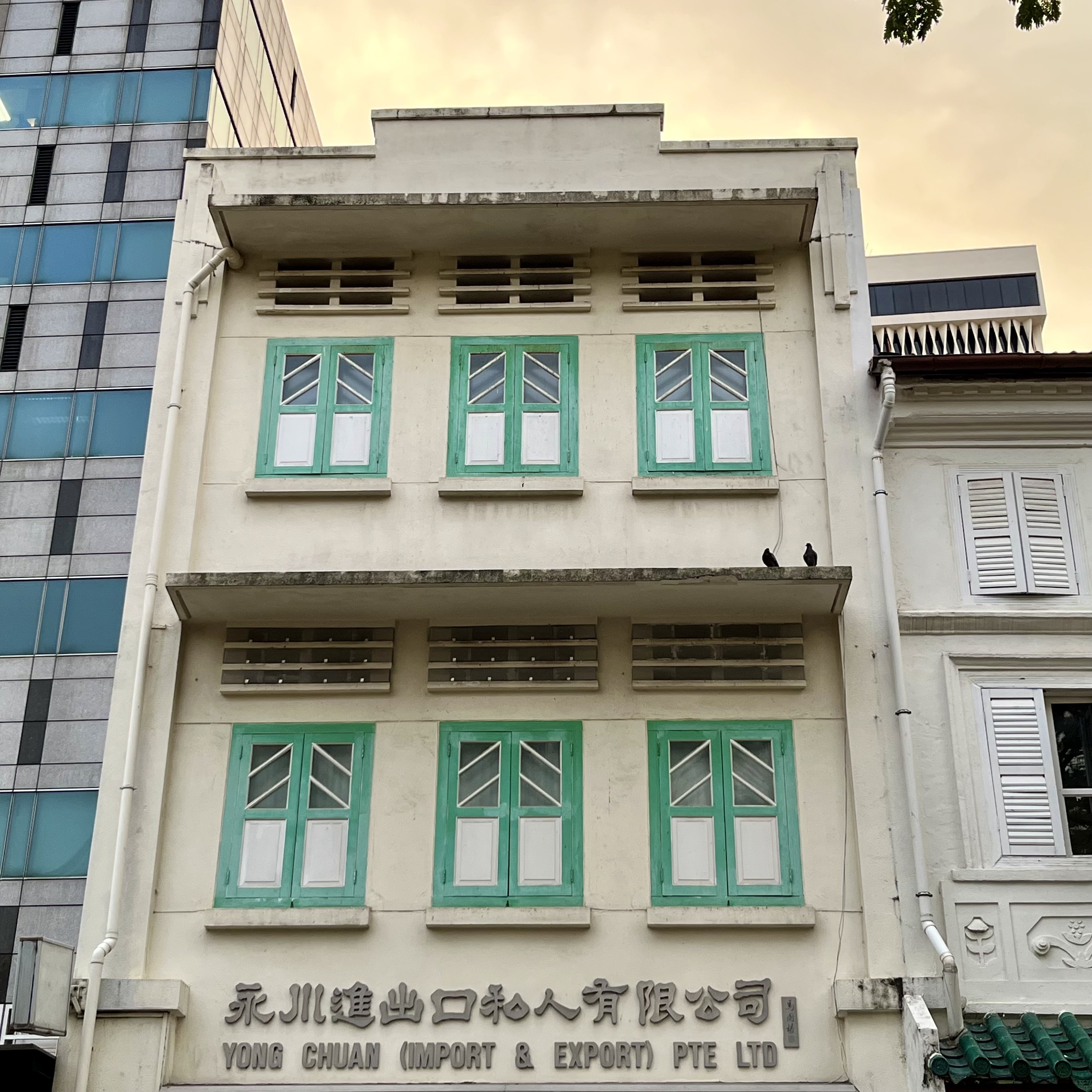
I spotted a couple of pigeons chilling on a ledge across from the temple one day. I felt at home. I usually encounter crows and mynas on my walk. Crows can often be found tearing entrails from dead rats. Mynas are cheeky little birds that don’t fear people. On the more tropical side, I’ve come across a hornbill, a blue-winged pitta and a ruddy kingfisher, which is a migratory bird that likely got lost. Side note: an acquaintance who lived in Singapore for several years had ornithophobia specific to pigeons. His shrink suggested carrying a dead pigeon in a bundle of newspapers to help address his fear. Never happened. Even a photo of a pigeon was enough to set the guy off.
Thian Hock Keng Shrine
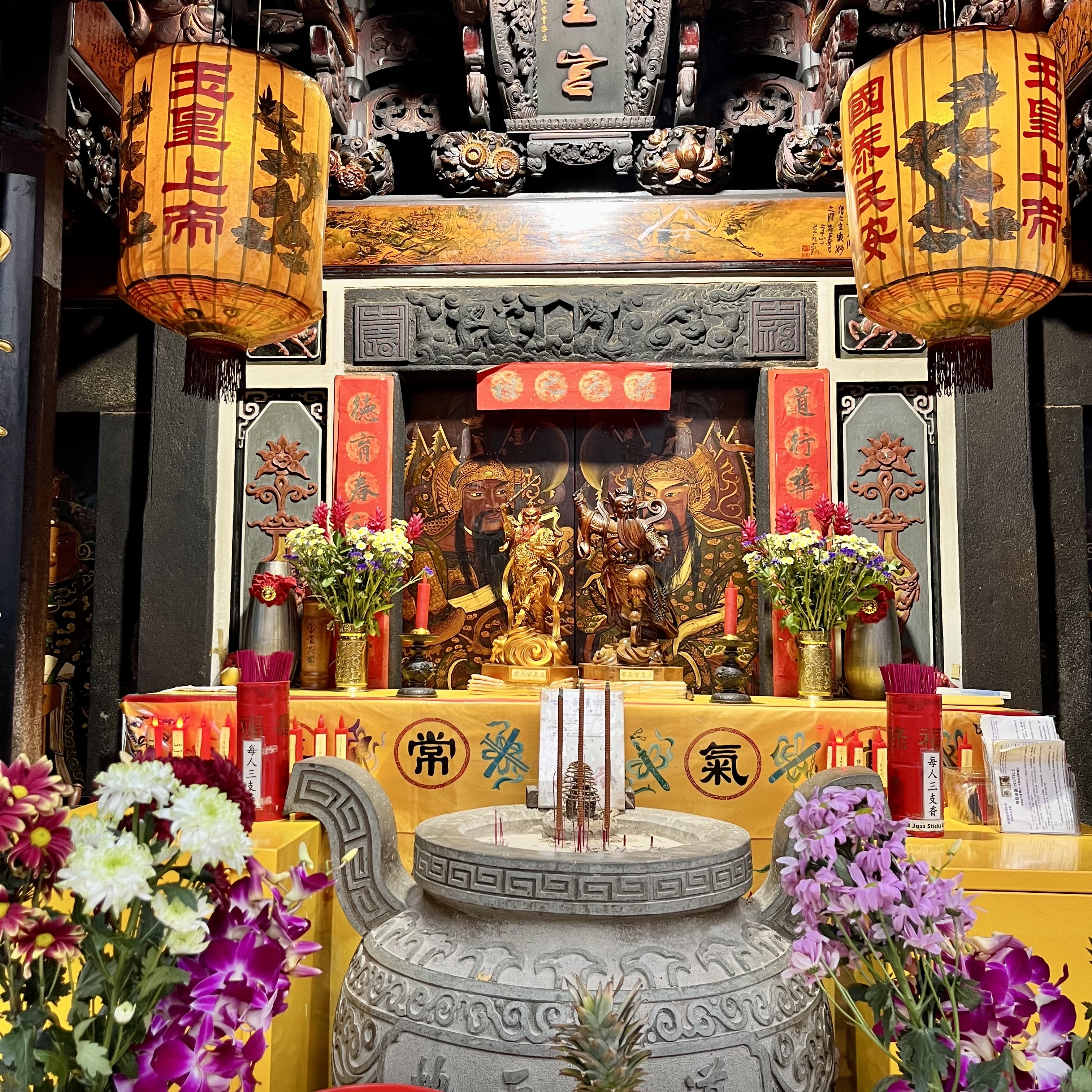
Back to the temple, there’s a little shrine at the far end. Some people bow to the shrine. Others stop for a few seconds to say something. It’s all very fast. Drive-by prayers make it feel like some sort of spiritual carwash. There are four prominent characters across the yellow cloth. Only two are visible in the photo: 常 (cháng) — constancy, continuity 氣 (qì) — breath, energy, life force These words, along with the obscured ones, express wishes for lasting joy, rising fortune and good qi surrounding devotees.
Nagore Dargah
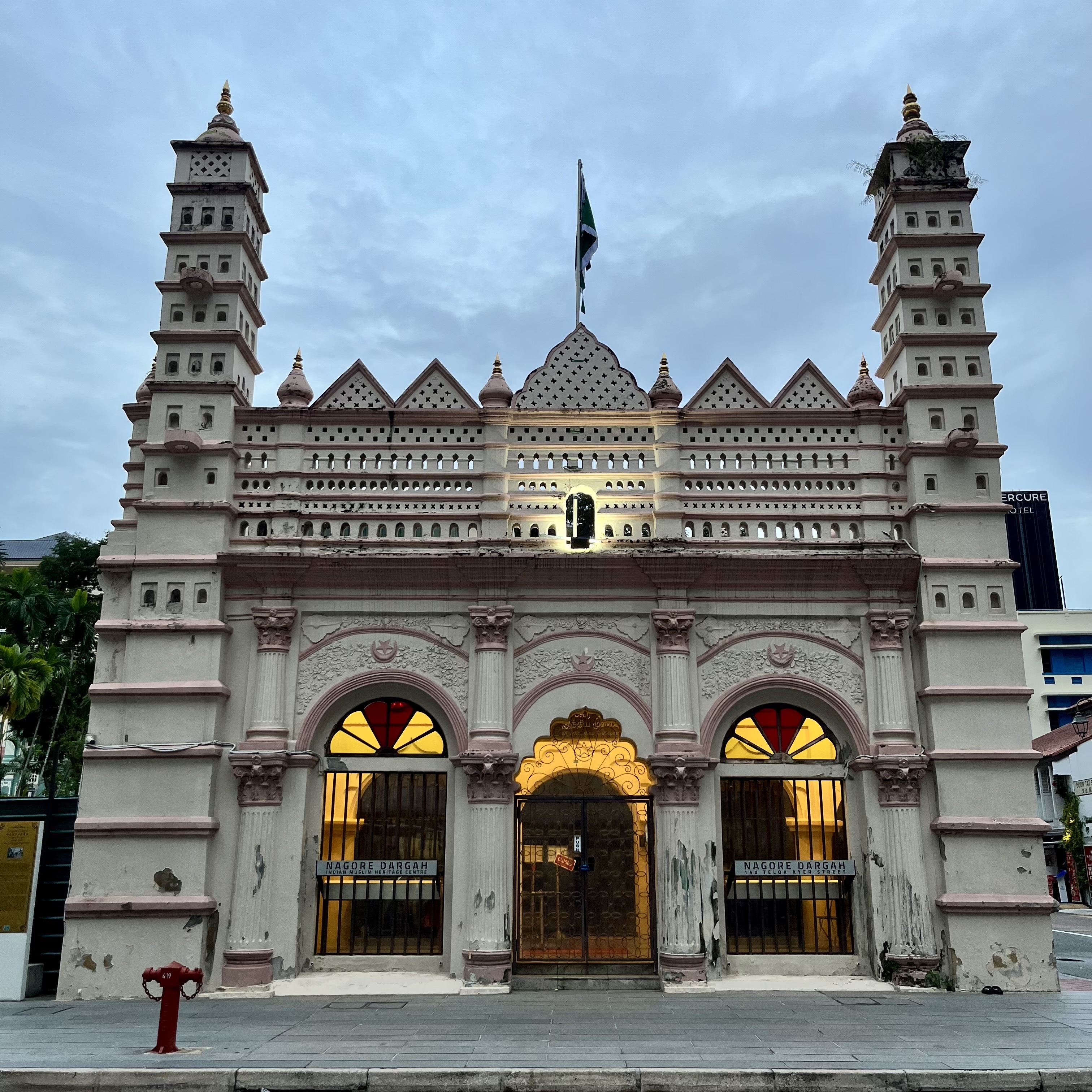
Beside the park we encounter Nagore Dargah, the fourth and final religious structure on the street. It was built between 1828 and 1830, making it one of the oldest religious buildings in Singapore. The Chulias from South India built Nagore Dargah in memory of a holy man called Shahul Hamid. The shrine was gazetted as a national monument in 1974. Then it fell apart. The shrine was boarded up in the 1990s and closed to the public due to concerns that its structure was weak. The monument underwent major restoration works in 2007, after which it remained closed to the public. In 2011, it was converted into the Nagore Dargah Indian Muslim Heritage Centre, showcasing Indian Muslim culture and heritage.

Free the Robot
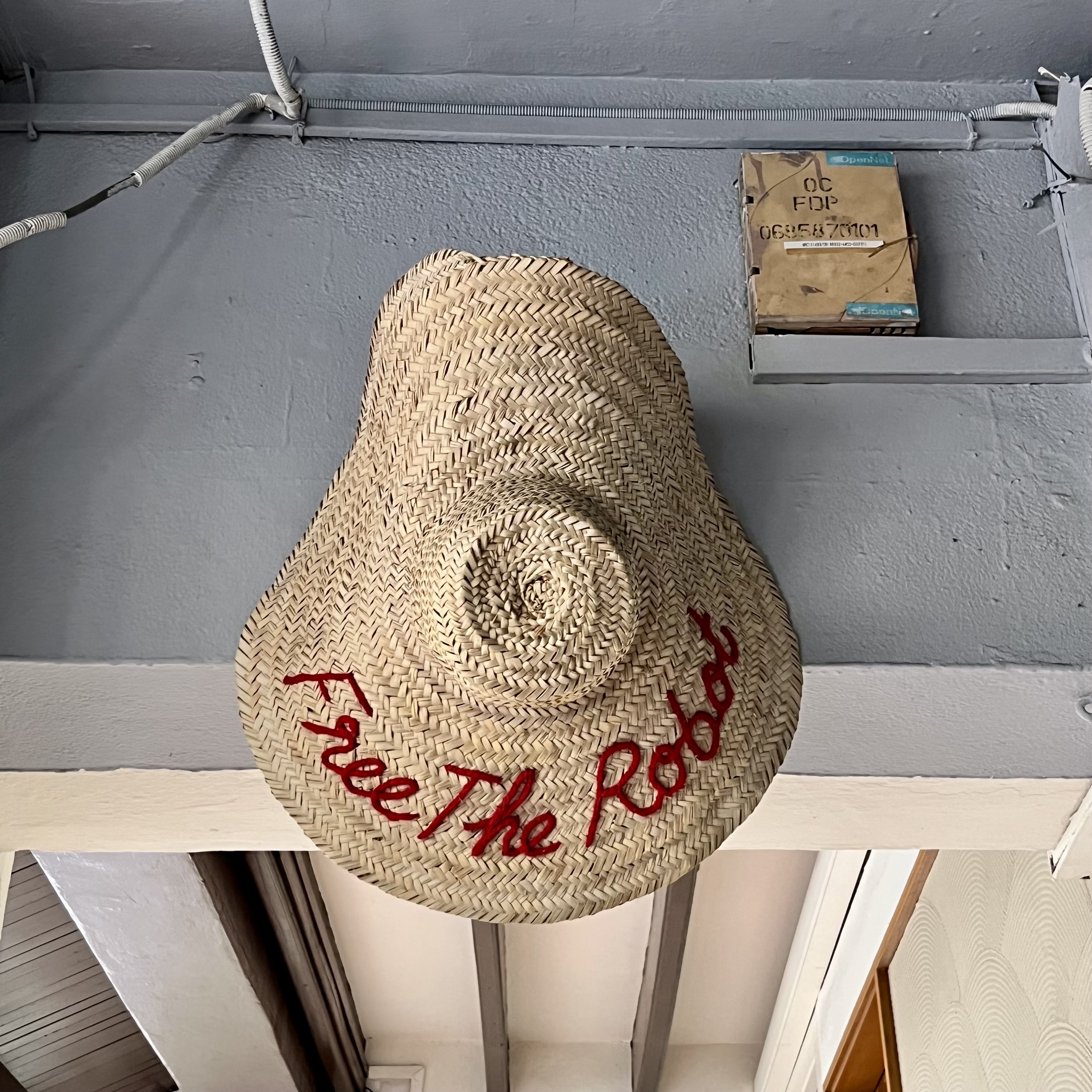
On the next block, a hat hangs above the entrance to Free the Robot. It’s a nice coffee joint during the day. At night, it becomes a bar called Bitters & Love. I took a lot of pictures on my walks to work. Few of the photos I’ve included here are unexpected. My telling focuses more on historical elements. I’ll make another pass later on, pointing out flora, fauna, birds and found objects. For now, I included this hat as an example of something I walked past every day for years without noticing. It wasn’t until I slowed down and looked around that I saw it.

Stickers - A Rare Sight
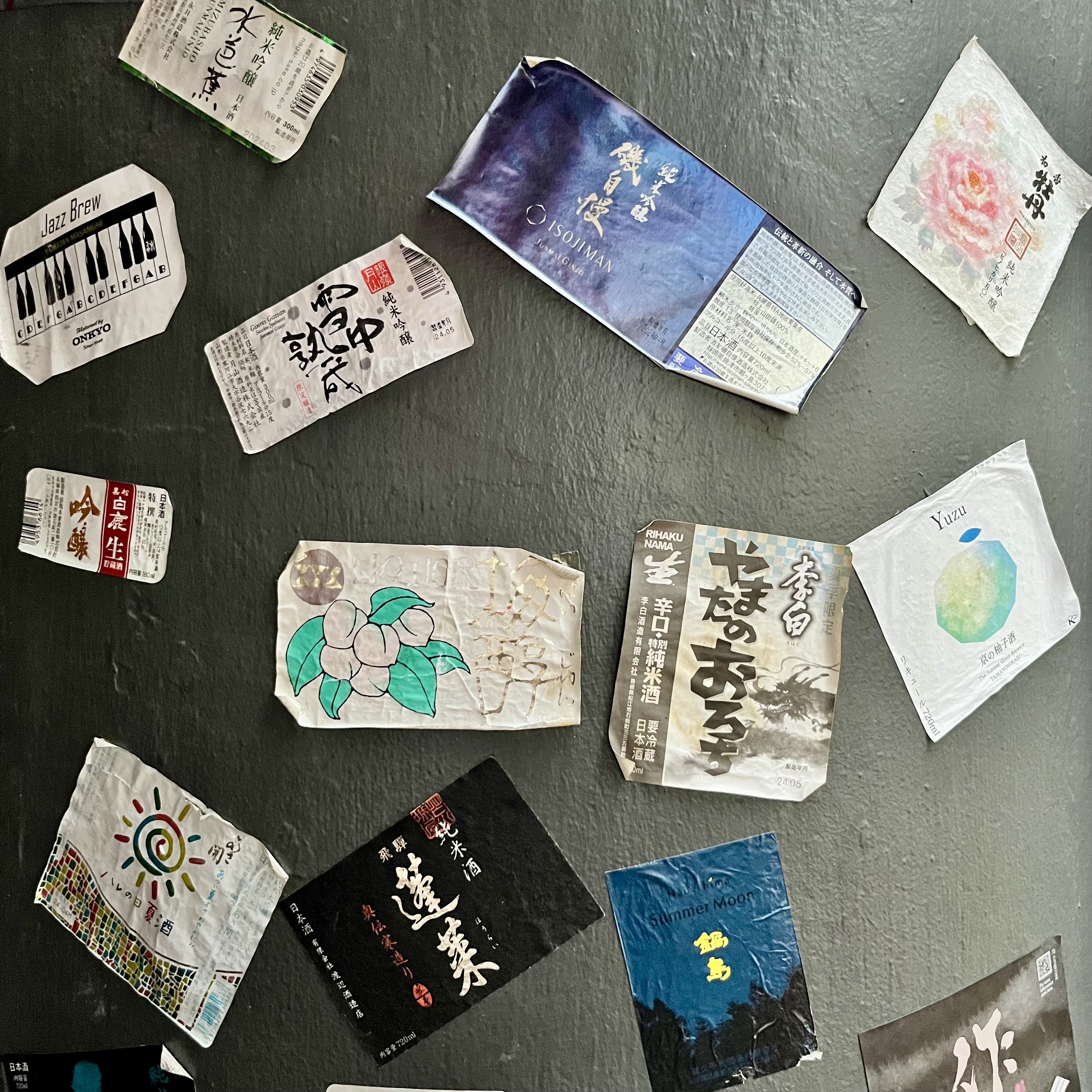
I noticed stickers on a pillar outside a restaurant. In most places, this would be unremarkable. In Singapore, stickers can get you in trouble. The stickers call to mind the story of Sam Lo (AKA Sticker Lady) from 2012. In short, she stuck sassy stickers onto buttons at pedestrian crosswalks around the city and spray-painted messages on roads. The stickers said things like “Press to time travel” and “Press for Nirvana.” She was eventually arrested. Lo’s arrest sparked a debate. Around 14,000 people signed an online petition calling for leniency in the way she was treated. She could have gotten up to three years in jail. In the end, she was charged with 15 counts of mischief and fined. In turn, that story reminded me of Michael Fay, an American arrested in Singapore for vandalism in 1994. He stole a few street signs and vandalized 18 cars. The police caught him. He pled guilty in court and was sentenced to six lashes with the cane. The sentence sparked diplomatic tensions between Singapore and the US. Fay’s punishment was ultimately reduced to four lashes. I remember this because there was a TV interview after he returned to the US. Fay claimed that he shook the prison officer’s hand after the caning. My stepdad exclaimed, “He’s full of shit!”
Cross Street
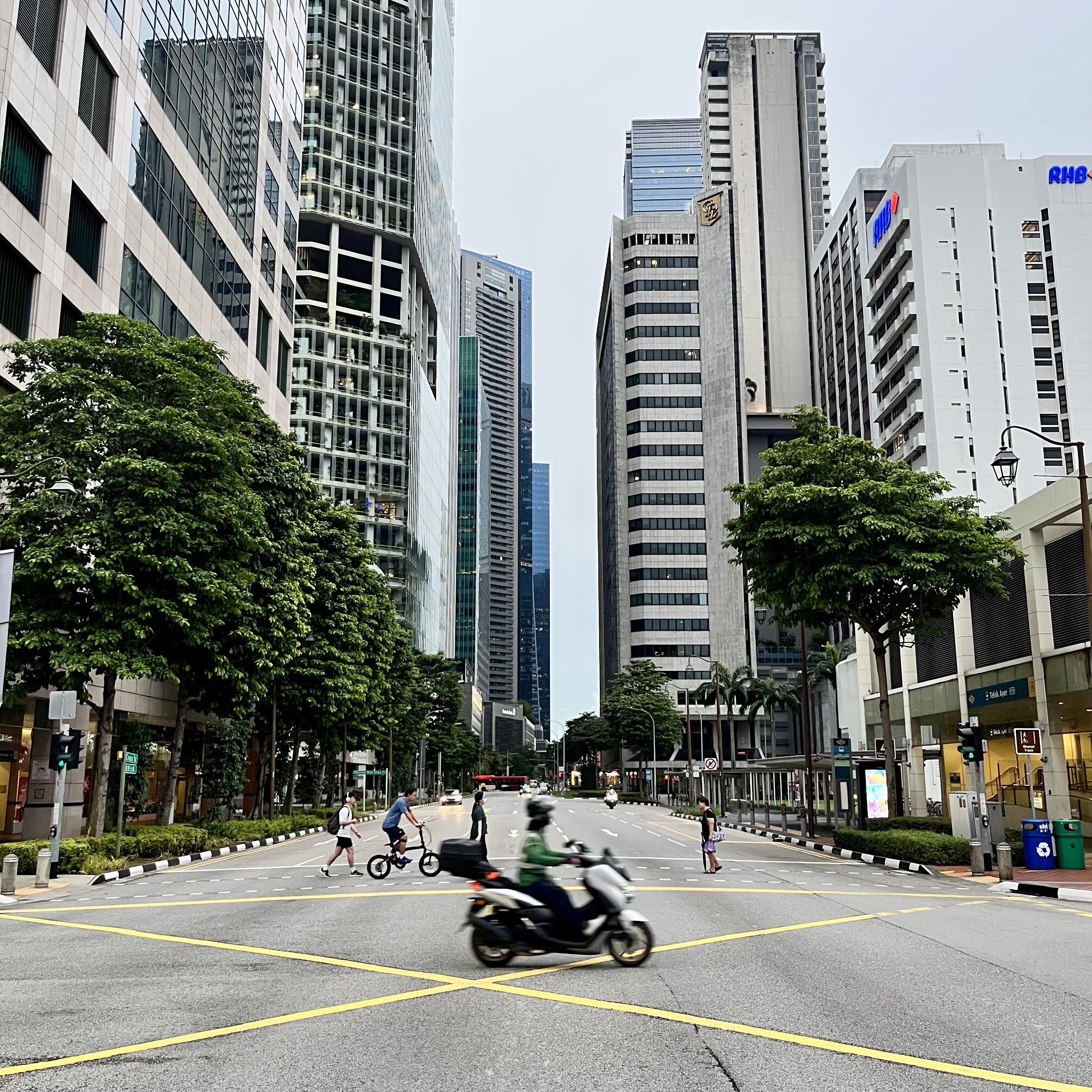
Cross Street marks the final stretch of my walk. It’s one of the oldest streets in Singapore and was featured in the first implementation of Stamford Raffles’s plan for Chinatown. Raffles was a British colonial official largely credited with the founding of contemporary Singapore. Cross Street is one of the main arteries cutting through the Central Business District. It intersects with several historic streets including Telok Ayer Street, Amoy Street, China Street, South Bridge Road, New Bridge Road, Robinson Road and Cecil Street.
Zhengzhou Sculpture
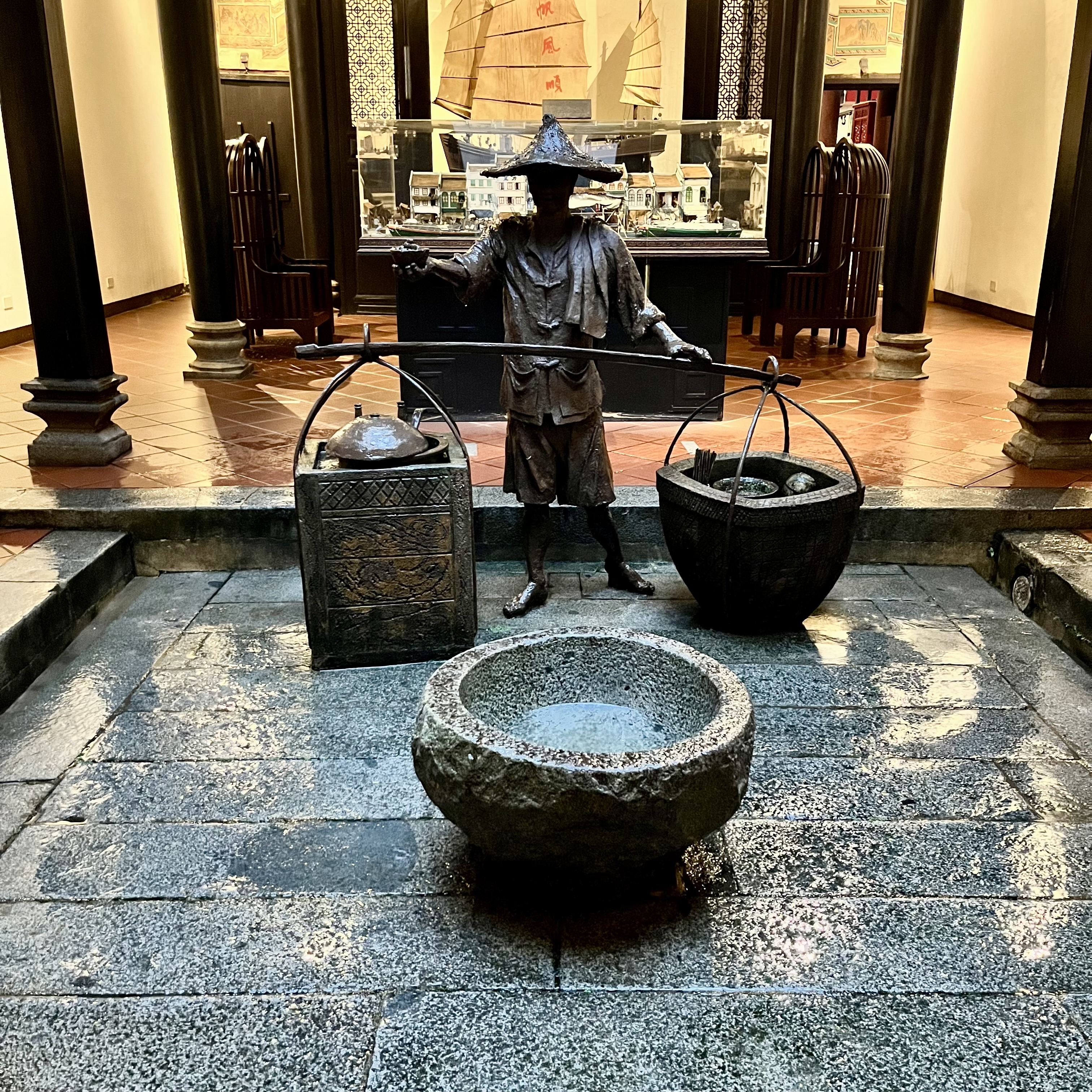
After Cross Street I pass the AMOY Boutique Hotel. A sculpture at the entrance depicts the people of Zhengzhou who came to Singapore by sea from China. The sculpture is exposed to the elements all year round and was in need of attention to fix various cracks and significant holes, as well as to give it a general repaint using a heavy-duty, specially formulated outdoor paint. Even after the restoration, the sculpture doesn’t look great up close. But it’s nice at a distance, especially when it’s raining. The building around the sculpture is more interesting. It housed Fuk Tak Chi, one of Singapore’s oldest Chinese temples, from the 1820s until 1994. The temple’s patron deity was Dai Bak Gong, which means God of Wealth and Merit in Mandarin. The temple was converted into a museum after closing in 1994.
The Forest (I)
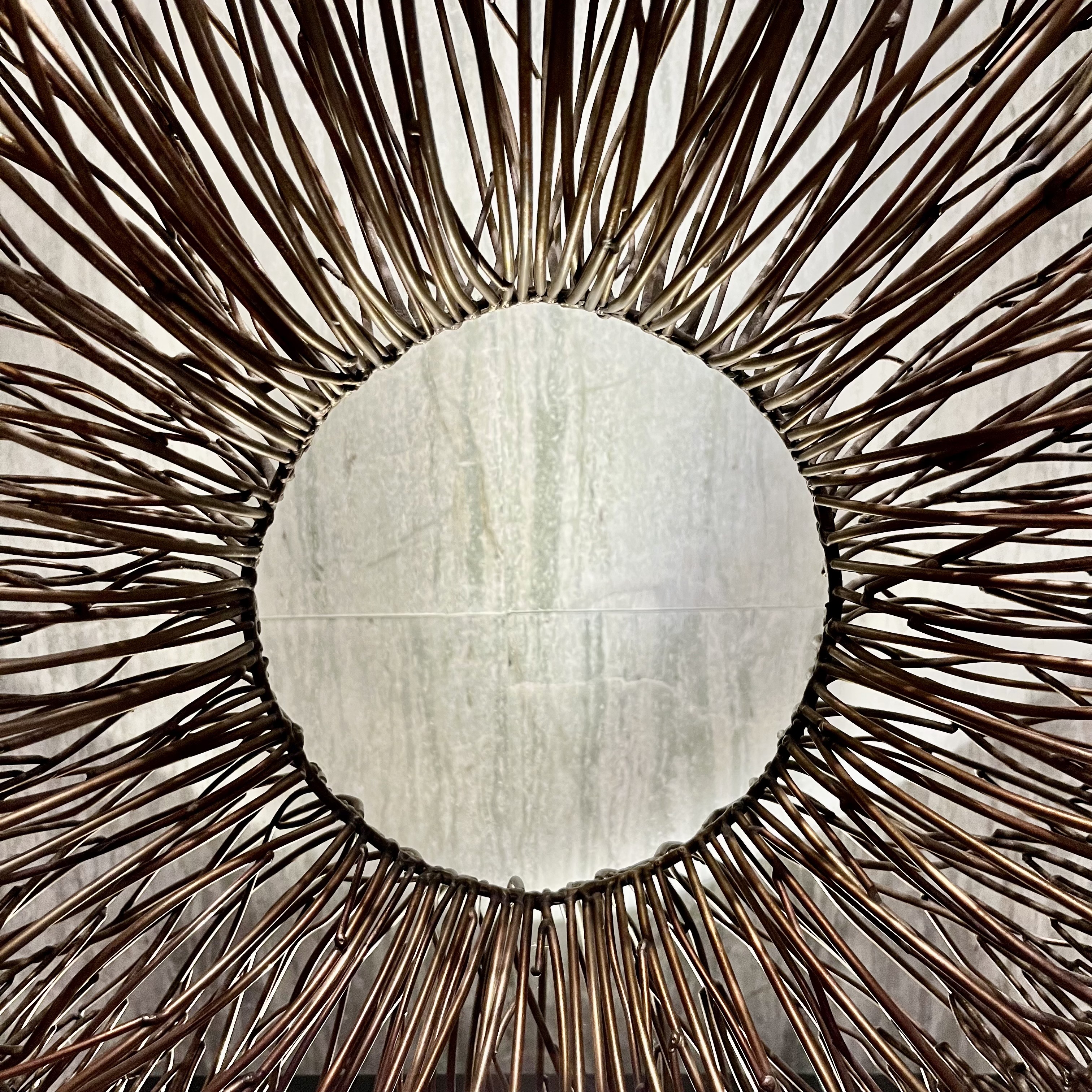
Inside our office building, there’s a sculpture by Korean artist Choi Tae Hoon near the lifts. The sculpture is called Forest (I). Choi used a plasma torching technique to cut and weld stainless steel into little branch-like shapes. According to Choi, it stands for the harmonious communications and relationships between humans. The composition of branches that materialize in the shape of “人” (meaning “human”) hold each other and lie upon one another. It ultimately reflects each individual’s importance within the community. The photo on the right shows the center of the sculpture.
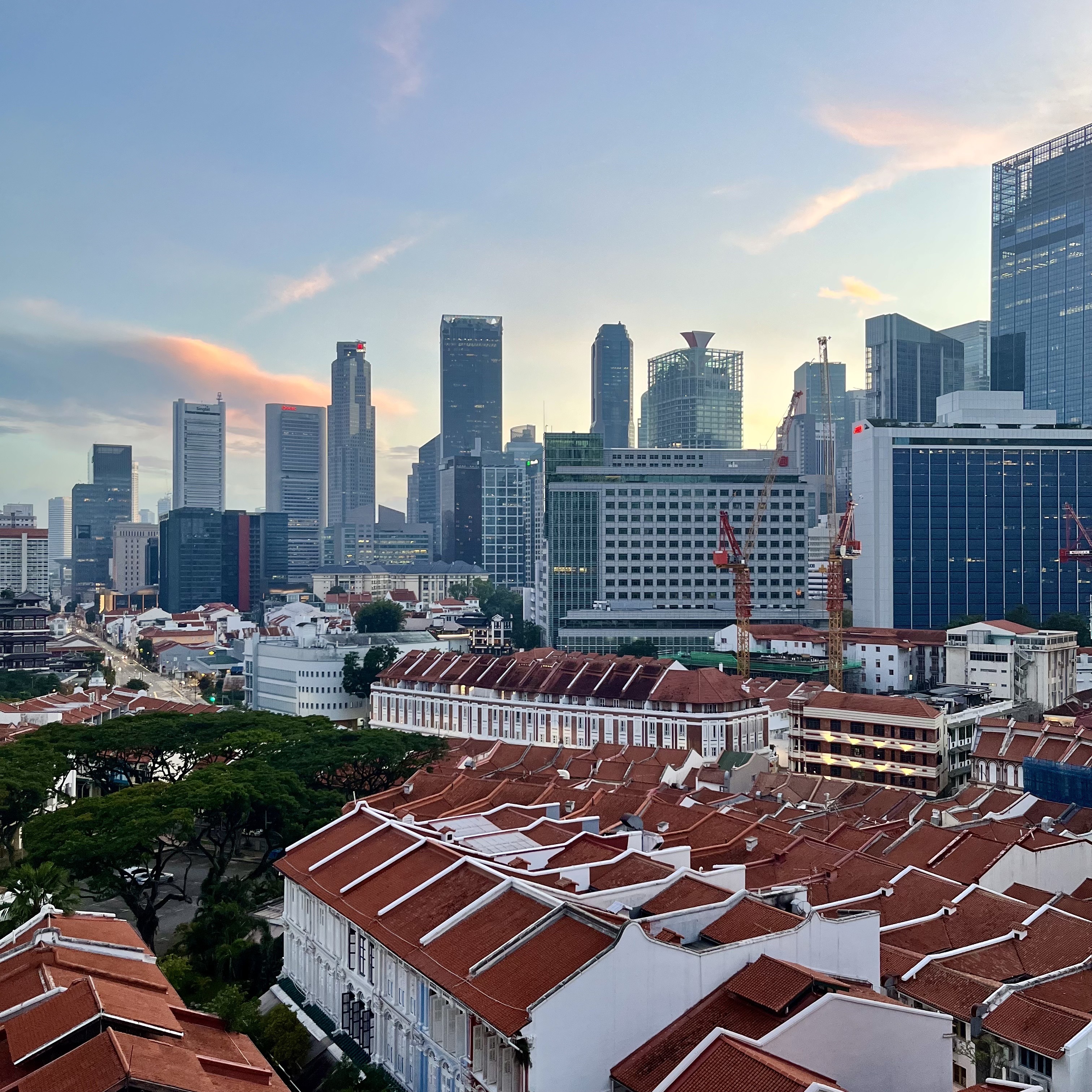
The View from Our Office
We end with a view of the skyline from our office. The very large connected building in the distance is The Pinnacle@Duxton. My apartment is in the small red-roofed building in the center of the frame, just below Pinnacle.