The Two Million-Year-Old Self
Anthony Stevens
I appreciate Jungian psychology. Yet I find it easier to approach Jung through the generations of analytical psychologists who followed him. Jung’s writing can feel overly academic, and his ideas sometimes seem less refined than those who came after.
James Hollis offers the most practical applications. Murray Stein does an excellent job simplifying and clarifying Jung’s thought. Marie-Louise von Franz, Jung’s disciple, is hard to beat when it comes to exploring the ideas in depth. Others have much to offer, but these are my favorites.
I go through phases with Jungian psychology. I’ll blast through ten books in a couple of months, take a year off, then return. I’ve just started another phase, this time with Anthony Stevens, who has written on dreams, symbols and Jung himself. I chose The Two Million-Year-Old Self because of its parallels with behavioral biology and evolutionary psychology.
The book itself was hard to find. I ordered a used copy that once belonged to a doctor in California. A note inside reveals she first read it in 1994, then again in 1997, 2008 and 2012 before eventually buying a new copy. Nearly every page is highlighted and annotated. Total mess. I love that.
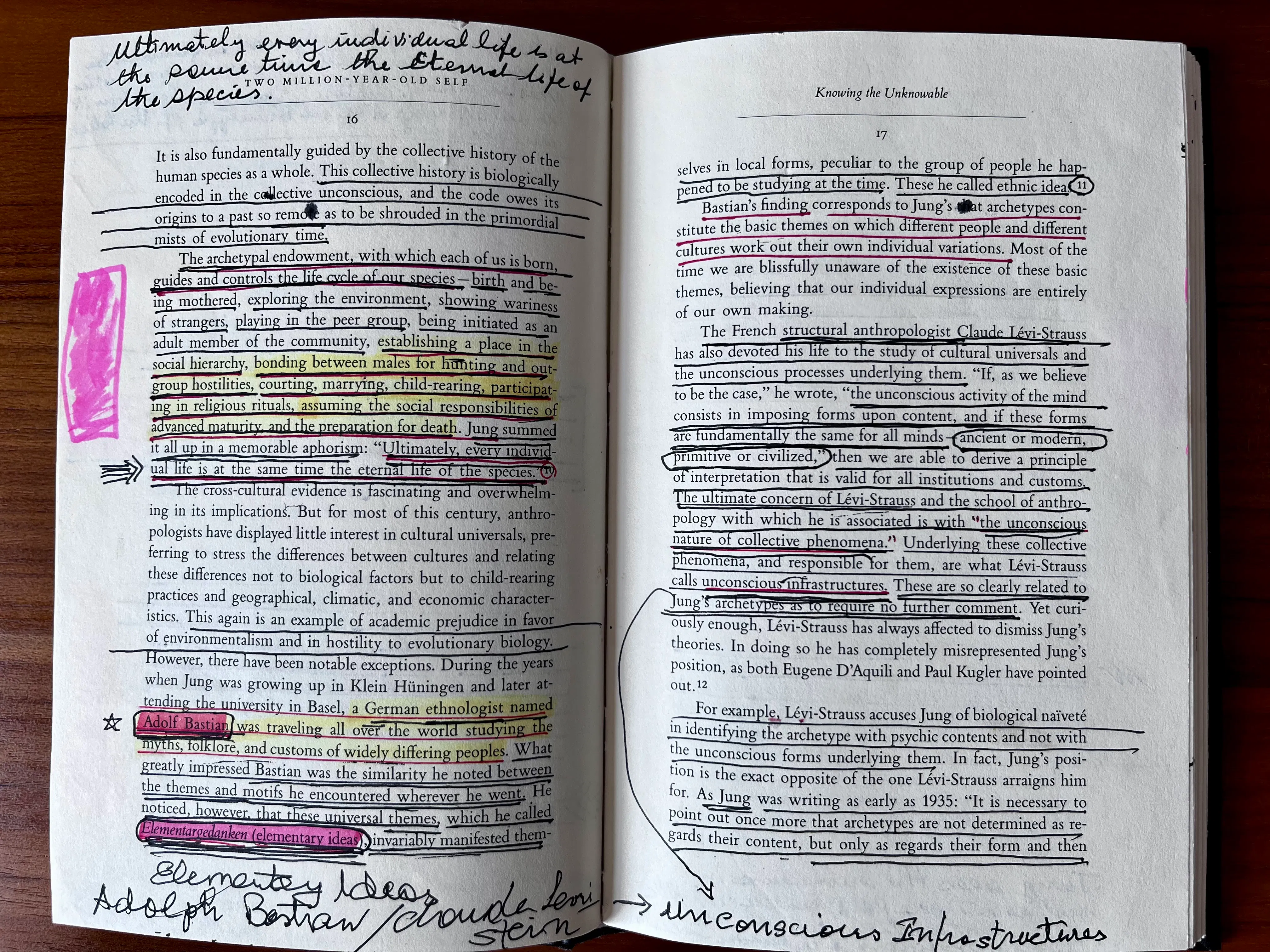
The book centers on archetypes, the most controversial element of Jungian psychology. Jung described them as a living system of reactions and aptitudes rooted in the collective unconscious that shape life in invisible ways. That formulation is a bit much for most people. A more accessible explanation is that archetypes are not inherited ideas but inherited possibilities of ideas.
Stevens argues that the archetypal endowment with which each of us is born guides the human life cycle: birth and being mothered, exploring the environment, wariness of strangers, play within the peer group, initiation into adulthood, establishing social rank, male bonding for hunting and out-group hostility, courtship, marriage, child-rearing, participation in ritual, assuming mature responsibility and preparing for death. Jung captured the idea neatly: “Ultimately, every individual life is at the same time the eternal life of the species.”
Archetypes are universal, inborn patterns of thought, behavior and imagery. The rebel, the sage, the hero, the magician, the mother, the father. Interpretations vary across cultures, but recognition does not. One culture can recognize the archetypes of another.
In the first section, Stevens builds a biological case for archetypes. He draws parallels with imprinting, with the innate mechanisms that allow children to acquire language and other species-specific behaviors.
As Jung insisted, the archetype “is not meant to denote an inherited idea, but rather an inherited mode of functioning… a ‘pattern of behavior.’”
The second section turns to dreams. Years later, Stevens published a major work on the subject, Personal Myths. I plan to read that next.
One detail stood out: a 1958 study comparing the dreams of 223 college students in Tokyo with those of 250 students in Kentucky. Across more than 7,000 dreams, researchers found striking similarities. A more recent comparison between Japanese and German dreamers found overlap as well.
Why the similarities across geography and generation? Stevens offers a concise line: “Great civilizations come and go, but the human psyche goes on grappling with the same issues, generation after generation.”
It reminded me of a quote from Thornton Wilder’s The Eighth Day: His midnight reading of the great historians confirmed his sense that Coaltown is everywhere—though even the greatest historians fall victim to the distortion induced by elapsed time; they elevate and abase at will. There are no Golden Ages and no Dark Ages. There is the oceanlike monotony of the generations of men under the alterations of fair and foul weather.
In the third section, Stevens argues that the “two million-year-old self” suffers in modern life because our environment no longer satisfies our evolved needs. The further our upbringing deviates from the environment of evolutionary adaptedness, the greater the risk of pathology.
To understand contemporary psychiatric disorders, Stevens suggests we must examine how Western society frustrates archetypal needs: weakened kinship bonds through migration and mobility, family disruption, inadequate childcare structures, the loss of myth and ritual, alienation from nature. These conditions generate stress, insecurity and distortion.
He then proposes five laws of psychodynamics. This is where he loses me. I agree with the first two. I can entertain the others in specific cases, but applying them universally feels like a stretch.
First Law: Whenever a phenomenon is found to be characteristic of all human communities, irrespective of culture, race or historical epoch, then it is an expression of an archetype of the collective unconscious.
Second Law: Archetypes possess an inherent dynamic, whose goal is to actualize themselves in both psyche and behavior.
Third Law: Mental health results from the fulfillment of archetypal goals.
Fourth Law: Psychopathology results from the frustration of archetypal goals.
Fifth Law: Psychiatric symptoms are persistent exaggerations of natural psychophysiological responses.
I enjoyed the book, but I wouldn’t necessarily recommend it broadly. I am, however, keen to read Stevens’ work on dreams.