The Atrocity Exhibition
J. G. Ballard
The Atrocity Exhibition marks my first experience with J. G. Ballard. It wasn’t my cup of tea.
Ballard eschews linear narrative, embracing experimental vignettes. I’m open to that. But the story was a repetitive mish-mash of auto-accidents, gore, fetishization, and obscenity. Hari Kunzru summarizes it well in his introduction. I quote at length:
“The novel presents fragments or avatars of a traumatized man, variously named Travis, Travers, Traven, Talbot or Talbert, who is conducting some kind of spun-out scientific experiment, which also takes the form of a lecture or media spectacle. Traven is both a researcher and an experimental subject or patient in an institution where white-coated medical science has become contaminated by other things: pornography, celebrity, the imminence of violent disaster. He is observed by one Dr Nathan and has a highly-fetishized sexual relationship with Karen Novotny or Catherine Austin or Coma, names for a blank, damaged woman who often seems to be constructed from fragments of female celebrities — Jackie Kennedy, Elizabeth Taylor, Marilyn Monroe. The Atrocity Exhibition visits terrible violence on these female celebrity bodies, in the form of plane and car crashes, nuclear fallout, disasters of all kinds. Ronald Regan and the car safety campaigner Ralph Nader get the same treatment. The book’s obscenity, the reason it still has the potential to shock, is a function of its objectivity. It is clinical when, for decency’s sake, it ought to feign emotion. It looks on our sacred treasures, our culture’s real sacred treasures — the imaginary bodies of famous people — and responds with all the violence and lust and revulsion that the healthy well-adjusted citizen suppresses.”
Ballard was assistant editor of Chemistry and Industry, a journal published by the Society of the Chemical Industry, when he produced a series of text-based collages that eventually became The Atrocity Exhibition. Maybe the chemicals went to his head.
Look: it’s gore. Ballard wants to offend people. He wants to shock people into feeling something. I’m not exactly sure what that is, though.
Here is a relatively benign passage:
“A Terminal Posture. Lying on the worn concrete of the gunnery aisles, he assumed the postures of the film actress, assuaging his past dreams and anxieties in the dune-like fragments of her body.”
That’s not so bad, right? The book gets weird, though. Ballard is the literary equivalent of David Cronenberg. In fact, Cronenberg adapted Ballard’s novel Crash. Both the novel and the film follow a group of car-crash fetishists who, inspired by the famous crashes of celebrities, become sexually aroused by staging and participating in car accidents. Ballard first explored those ideas in The Atrocity Exhibition.
In the edition I have, Ballard ends each section by providing context about what was on his mind while writing and how he connects parts of The Atrocity Exhibition to society. These notes were often interesting and provided a welcome break from the gore and horror elsewhere.
For instance, I learned of the poet Paul Éluard in one such section. Describing his wife, Éluard once said, “Her body is the shape of my hands.” A beautiful sentence, though it admittedly sounds like Éluard sculpted his wife. Perhaps “My hands are the shape of her body” would have been better.
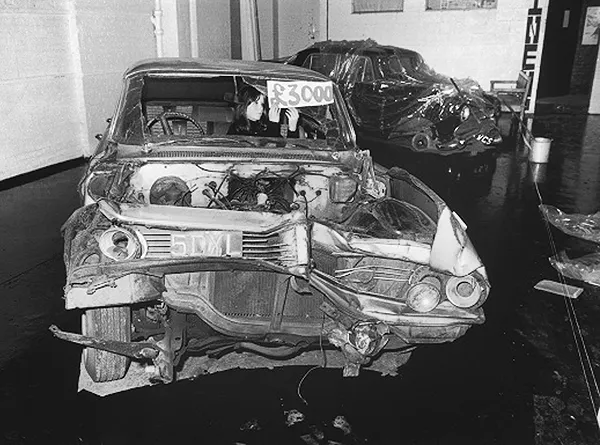
Unsurprisingly, Ballard was out there. In 1970, he staged an exhibition of crashed cars at the Institute for Research in Art and Technology. It ran for 24 days. The exhibits included three wrecked cars: a Pontiac, an Austin A60 Cambridge, and a Mini. At the opening, the cars were vandalized, covered in graffiti, and reportedly urinated in, which feels about as Ballardian as an audience response can get. The exhibition offended people.
I also learned, but haven’t verified, that the French surrealist Raymond Roussel traveled with a coffin in which he would lie for a short time each day, preparing himself for death. Seems unlikely, but it caught my attention.
I did find one relatable line in the story part of the book:
“He walked into the bathroom, wincing at himself in the mirror, that always more tired older brother.”
Damn, that hits hard.
My takeaway is this: If you don’t like body horror and offensive material, don’t bother with The Atrocity Exhibition. It’s not for you. And it wasn’t for me. I picked it up on a whim and read it on a plane. Plane time is dead time, so that’s okay. I’m glad to be back home reading something more interesting and intellectually stimulating now.
I’m not done with Ballard yet. A few of his other books look interesting. Empire of the Sun, Kingdom Com, Hello America and Rushing to Paradise. Though I won’t be racing to the stacks to get them just yet.