Dekalog I
Krzysztof Kieślowski
Pope John XXIII established the Vatican Film Library in 1959. He sought to preserve films and recorded television programs on the life of the Catholic Church. You know, Christmas mass and home videos of the archbishops dancing in sprinklers during the summer holidays.
Fast forward to 1995. By this time the archive has over 8,000 films. The collection moved from home videos to cinematic masterpieces. Popes enjoy film, too. In fact they enjoy it so much that, under the guidance of Pope John Paul II and cardinal John Patrick Foley, the Vatican Pontifical Council for Social Communications released a list of 45 films titled Some Important Films (alcuni film importanti) in honor of the 100th anniversary of the first moving picture. The holy cinephiles grouped the films into three categories based on what the Vatican perceived to be their merits: Art, Religion and Values.
Dekalog made the list for its values.
Hailed as Krzysztof Kieślowski’s masterpiece, Dekalog explores the ten commandments across a series of one-hour films. All ten films take place in the same austere Polish housing project, yet each consists of different characters and can be watched independently of the rest.
Dekalog I reflects the first commandment: I am the Lord thy God. Thou shalt not have other gods before me. Thou shalt not make unto thee any graven image. Thou shalt not bow down thyself to them, nor serve them.
We watch a precocious boy, Pawel, navigate questions of fate through conversations with his father and his aunt. Pawel’s father, an academic who teaches at the university, leans towards a scientific explanation of the world. At home, he bonds with Pawel over computers, solving equations. The computer always knows. Pawel’s father puts his faith in machines.
When Pawel relays his father’s views to his aunt, she speaks of religion and the soul. Yet the nature of her faith shines more clearly in front of the computer. Pawel has created a program that allows him to know what his mother is doing. While never stated, it seems she’s living abroad as the program calculates time zone differences. Each time Pawel asks what his mother is doing, the computer fails to answer. The computer doesn’t always know. Yet Pawel’s aunt answers without hesitation: She’s dreaming of you. She puts her faith in what can only be known in the heart. That includes God.
Further along in the story, Pawel receives ice skates from his father. Ecstatic, Pawel asks if he can skate on the lake the next day. His father calculates how much weight the ice can support; three times the boy’s weight. Still, Pawel’s father walks out to the lake himself to test the ice—perhaps a sign he has not put all of his faith in the machine. The next day, Pawel skates on the lake with friends. The ice cracks, and Pawel drowns in the frigid waters.
Here we’re invited to reflect on the first commandment. I am the Lord thy God. Thou shalt not have other gods before me. Even if the machine god provided correct calculations, the Biblical God had other plans.
If this is a story about false gods, then we are left with a harder question: where is the real one? Kieślowski may offer an answer in the form of a mysterious character who makes three brief appearances.
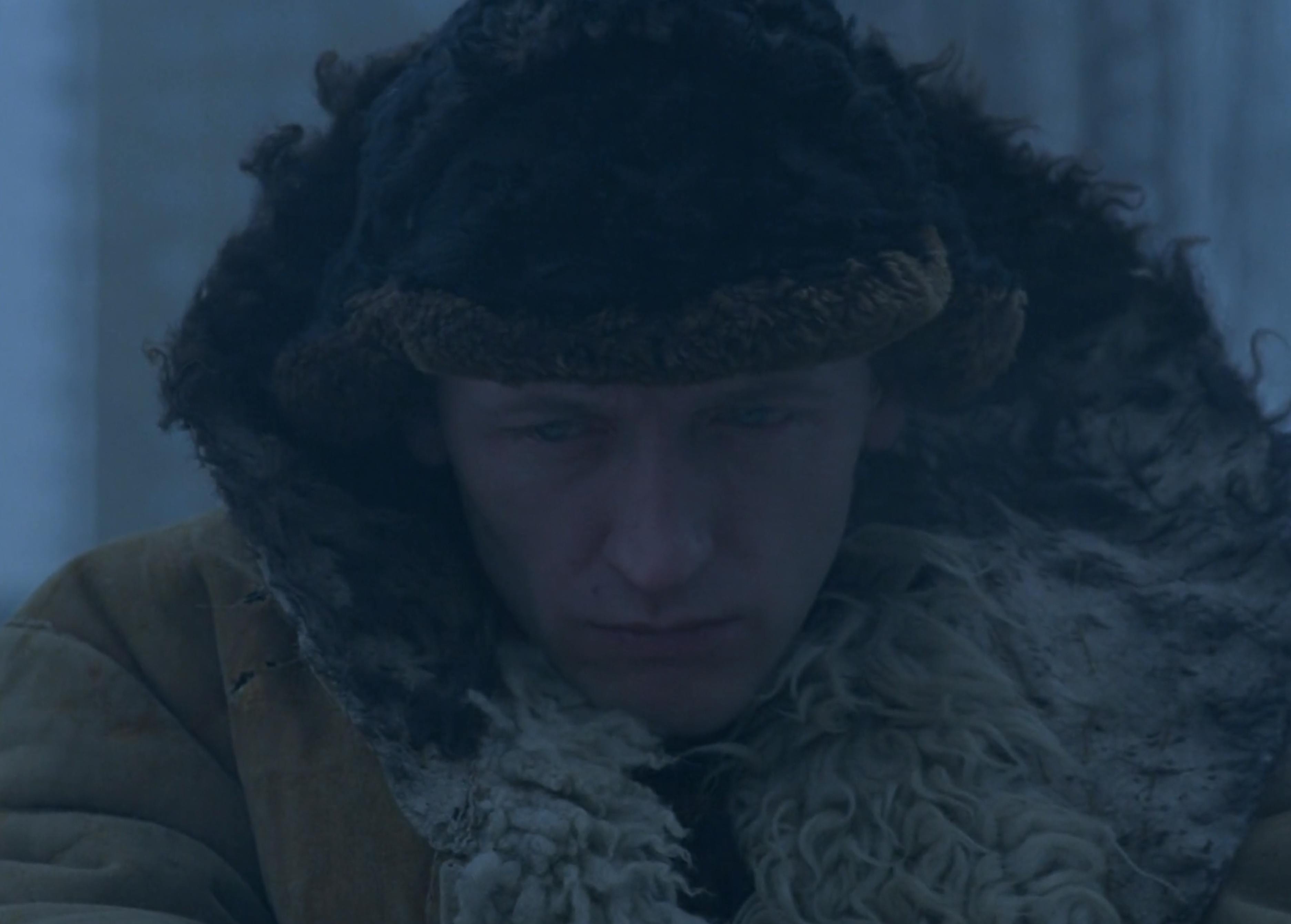
At the beginning of the film, a blue-eyed man sits beside the frozen lake, observing the ice in silence while warming himself against the winter before a small fire. We see this man a second time when Pawel’s father tests the strength of the ice. When Pawel dies, we see the man a third time though not physically; while rescuers retrieve bodies from the lake, we notice a black pile of smoldering ash where the man sat before.
I interpret this man to be God. His screaming absence in the face of tragedy raises the timeless question that every religious skeptic asks: How can God let something so horrible happen? Surely this man could have helped if he were there when the ice cracked. What God wouldn’t help given the chance. Yet, if he wasn’t there, why not? Was he even there to begin with?
The mysterious man is but one of several symbolic visuals that Kieślowski employs. Another fantastic example comes while Pawel’s father is grading assignments. A pot of blue ink begins to leak, spilling deep blue puddles across white pages spread across the desk. This happens around the same time Pawel is out skating on the lake and, presumably, at the same time that the ice cracks.
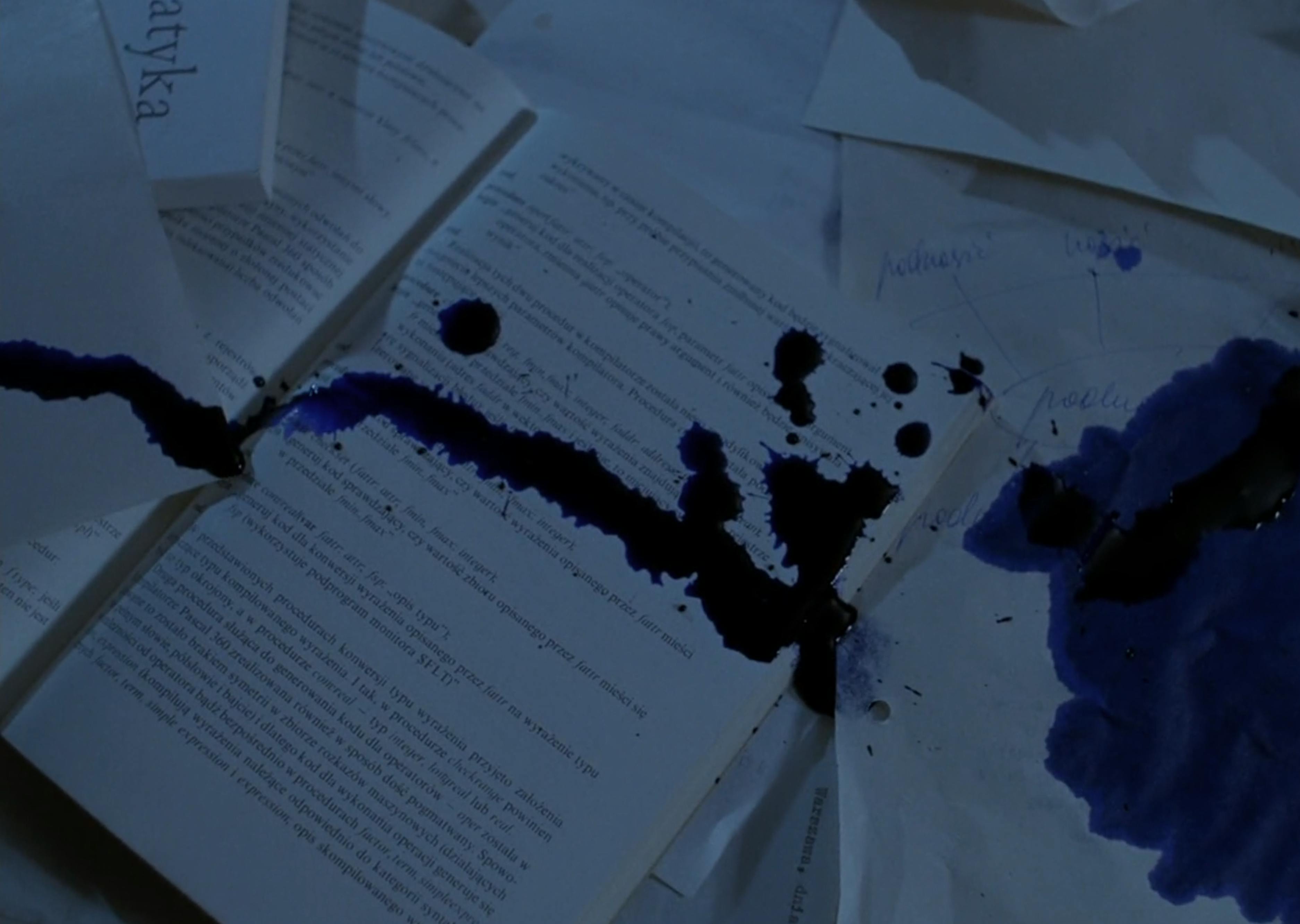
Kieślowski quickly deepens the visual metaphor. We all know what it means to say someone has blood on their hands. Scholars tie the idiom to the Old Testament. In Deuteronomy 21:6-9, elders wash their hands to declare they are not responsible for a death. Isaiah 59:3 also mentions hands stained with blood as a sign of guilt. In Dekalog I, Pawel’s father runs to the sink to wash blue ink from his hands. Here we might say he has blue on his hands, yet the meaning is the same.

Dekalog I hits hard. Kieślowski turns serious religious material into a harrowing story about faith and the nature of God. It calls to mind the final passage in Thornton Wilder’s The Eighth Day: There is much talk of a design in the arras. Some are certain they see it. Some see what they have been told to see. Some remember that they saw it once but have lost it. Some are strengthened by seeing a pattern wherein the oppressed and exploited of the earth are gradually emerging from their bondage. Some find strength in the conviction that there is nothing to see. Some
Wilder ends with a single word without a full stop. Kieślowski ends with a full stop and leaves you to imagine Pawel’s father searching the arras to understand why his God failed him.